
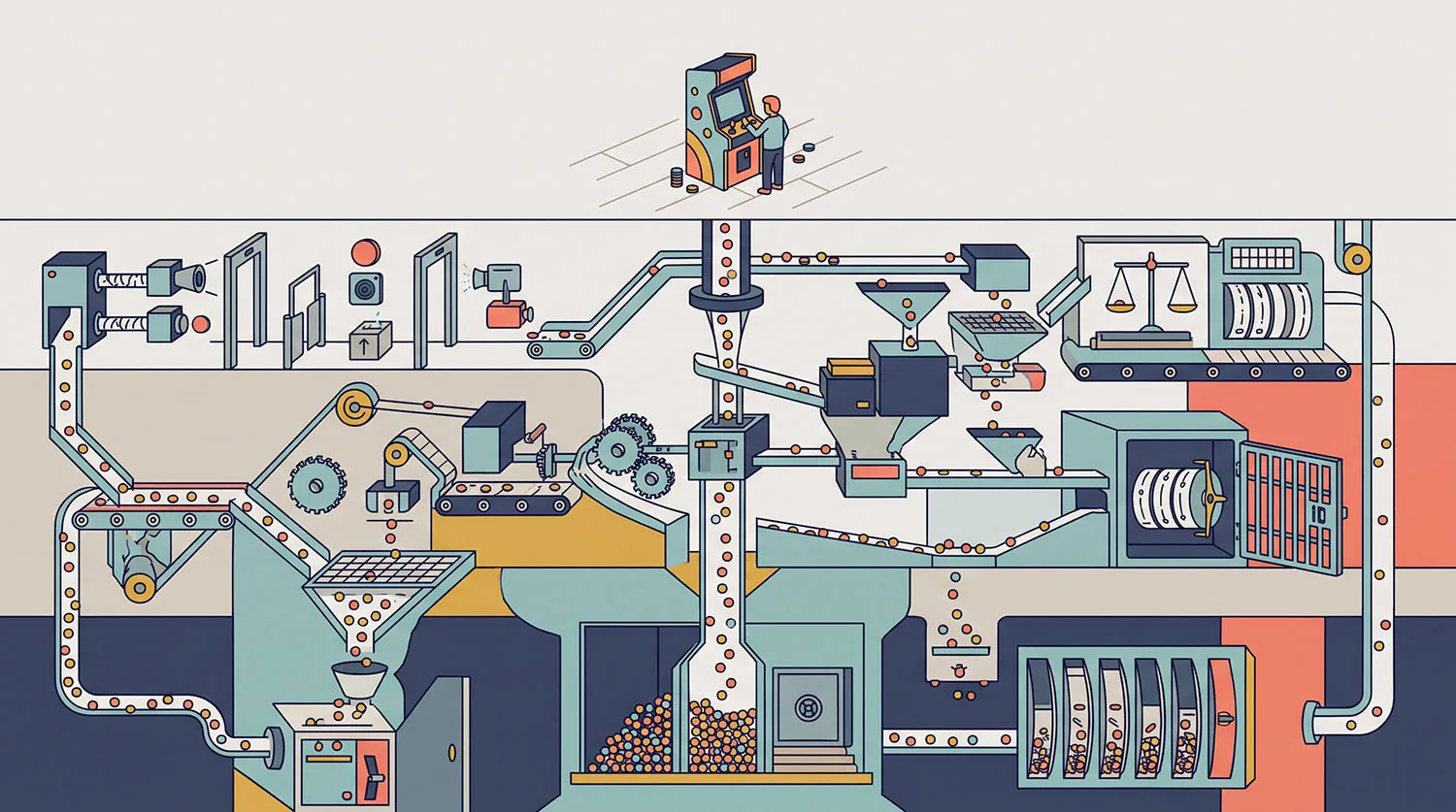
The game is the easy part. We say that with love, and with full knowledge of how hard games are.
Art+Logic built the server side of a real-money mobile game: paid-entry contests, cash prizes, real bank accounts on both ends. The game team built a game. We built everything that has to be true before the game is allowed to touch money. That turned out to be most of the project.
If you’re a small developer wondering how to add real-money play to your game, this is the briefing we wish someone had handed us on day one. It is not legal advice. We know this because we have paid for legal advice, and it reads differently.
What does real money add to your backlog?
On our project, eight systems sat alongside the game itself. A useful way to scope them is to ask what each one needs to tell a player, an operator, or the person answering support email.
| System | The question it had to answer |
|---|---|
| Identity and age verification | Can we establish who this player is and whether they meet the age requirement? |
| Geolocation | Is the player in a location where this contest is available? |
| Payments | Did the deposit or withdrawal go through? What happens if it comes back? |
| Wallet and ledger | How much can the player enter in a contest or withdraw, and can we explain that balance? |
| Anti-money-laundering controls | Which patterns of deposits and withdrawals need a closer look? |
| Tax reporting | Does the filing provider have the information it needs when reporting is due? |
| Responsible play | How does a player set a limit or exclude themselves, and where does the system enforce it? |
| Admin and audit | Can support investigate a disputed payout and see who took which action? Otherwise, support runs on database queries and hope. |
Most of the interesting questions showed up where two rows met. Take what looks like a straightforward $20 deposit.
Why can a player have an available balance while their bank transfer is pending?
On our project, the payment partner could approve the deposit up front. The player could use the money to enter a contest while their bank still showed the transfer as pending. Both screens are correct. Your support inbox will hear about it anyway.
Now suppose the contest finishes, the prize is paid, and the deposit that funded the entry comes back. That’s a good scenario to walk through with a prospective payment partner. What does the partner tell your server? What does the player see? Can the person answering the ticket explain how the balance got there?
Most of the code in a wallet is the word “unless.”
How do you test a system designed to distrust your testers?
Ask each vendor which failures you can reproduce in its sandbox. A successful test deposit tells you very little about what your app will do when an identity check fails, a location check comes back inconclusive, or a withdrawal is already in progress.
Every vendor on our project gave us two environments: a sandbox and production. Nothing in between. Want several test accounts in production? From the vendor’s side, that looks like one person turning up with multiple identities. Our test plan, read aloud, was a fair description of a fraud ring.
Ask each vendor what test hooks they offer. Build simulated responses into your development environment so you can check what your app does when the answer is no. Then agree with the vendor on how to exercise the integration itself. Those are two different tests, and it helps to know before launch which ones you’ve actually run.
Why did account deletion take so much work?
A player can ask to close an account while the system still owes them money. That turns one button in Settings into a surprisingly good test of your product design.
What if the account holds a balance? A pending withdrawal? An open contest entry? Winnings that still have to be reported? The person building the button needs to know what can close immediately, what still has to settle, and what the confirmation email can honestly tell the player.
We built a surprising amount of software for features with very little traffic. Size them by their rules, not by their usage.
Which vendors do you need, and what takes the longest?
For our project, the main outside dependencies were identity and location checks, payments, and tax filing. The most useful scheduling question for each provider was simple: “What has to happen before you’ll give us production credentials?”
A sandbox account let us start writing code. Onboarding, underwriting, legal review, and certification each had a calendar of its own. There was work on the game side, too. If a vendor ships a native mobile SDK and your game uses an engine such as Unity or Godot, decide early who will write and maintain the piece that connects them.
One of our bigger surprises arrived as a single word: escheat. We looked it up. What began as a question about unclaimed balances became dormancy tracking, player notices, and a reporting process. Read every vendor’s terms and every memo from counsel as a requirements document, because that is what they are.
And choose vendors who will get on a call. When your question is “what happens if a deposit is returned after the prize was paid,” you want a person.
Who runs the game after launch?
Picture the person opening a ticket that says, “I won. Where’s my money?” Build the admin tools for that person, who is probably not an engineer. They need to see the contest result, the wallet entry, the withdrawal status, and any restriction that affects the payout. They also need to know who can resolve it.
Then there’s the language. The app has text. So do the hosted web pages, the error messages, the success messages, and the emails. The most carefully reviewed sentence in our app is the one a suspended player sees. It says almost nothing, on purpose, and it took longer to settle than most features. Keep one inventory of player-facing language from the start. When the wording changes, you’ll know where it has to change with it.
Before you pick a launch date, take one contest and follow one player’s money all the way through it. Do it once when everything works. Then cancel the contest or return the deposit and walk through it again. Who decides what happens? Where is that decision recorded? Who explains it to the player? The first question nobody can answer is a good place to spend your next planning meeting.
If you’re a game developer weighing real-money play, we’re glad to compare notes before you commit to a path. Bring your game design and your target states. We will bring the list of things nobody mentioned.