
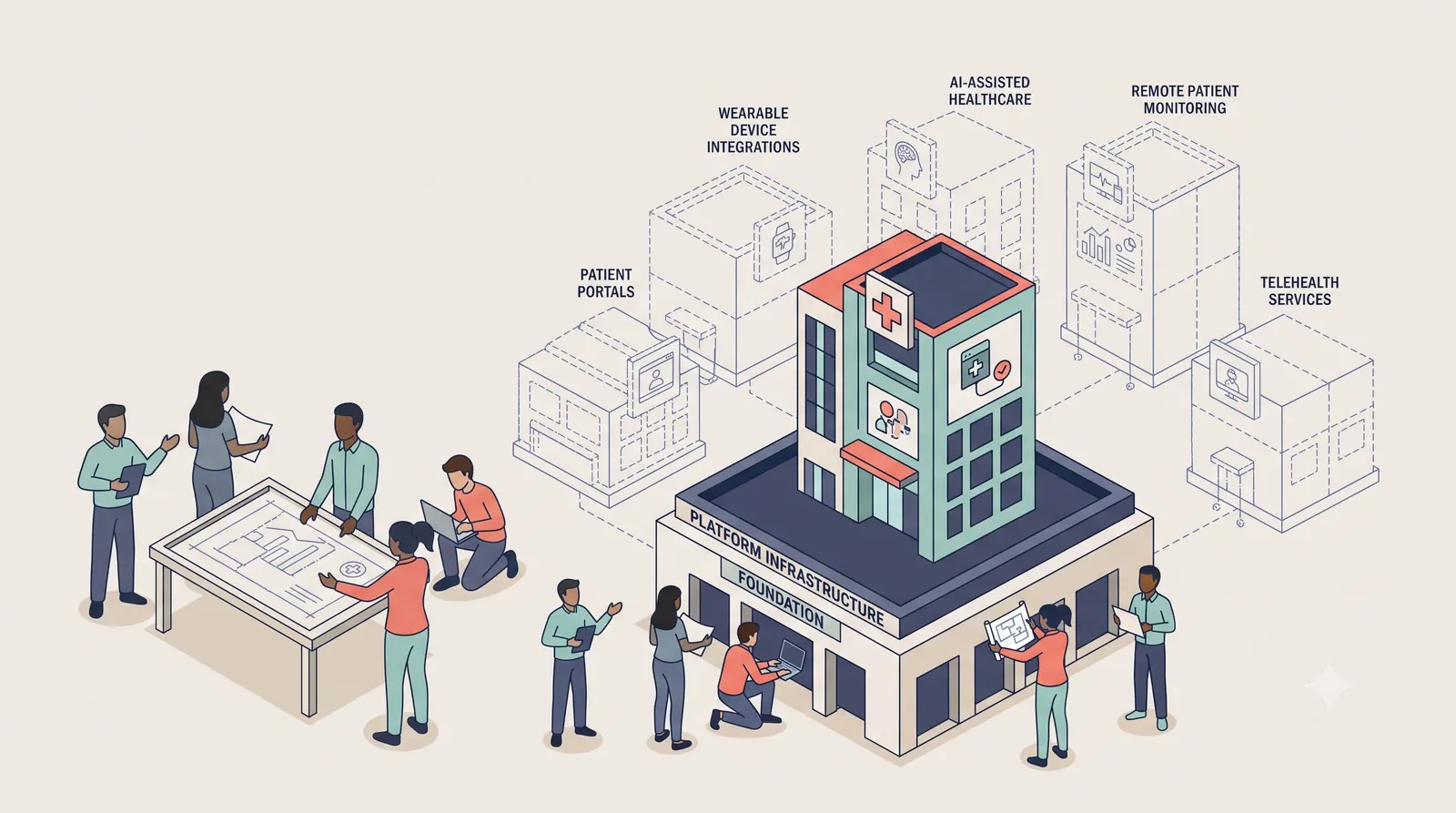
A medical application can work exactly as designed and still fall short of what the organization needs next.
It may deliver a diagnostic result, guide a clinician through a decision, help a patient manage a condition, or connect to a medical device.
But then the questions get bigger.
How does its data reach the rest of the care team?
Can the software support a new clinical workflow without creating a new compliance problem?
What happens when a framework, operating system, integration, or security requirement changes?
And can the product evolve without forcing the organization to rebuild it every few years?
What does it take to build a modern digital health platform?
A modern digital health platform needs more than a functioning Software as a Medical Device application. It must connect regulated clinical functionality with patient and clinician experiences, healthcare data, security controls, interoperability, validation, and a plan for ongoing change.
That means SaMD development, compliance, cybersecurity, UX, integrations, and software modernization cannot be treated as separate projects.
They are parts of the same product strategy.
Key takeaways
- SaMD may be the clinical core of a product, but it often operates inside a larger digital health platform.
- Intended use should shape product boundaries, risk analysis, architecture, validation, and regulatory planning from the beginning.
- Compliance is usually faster when traceability and validation are built into development rather than reconstructed afterward.
- Fast Heathcare Interoperability Resources (FHIR) and other interoperability standards help systems exchange data, but they do not guarantee that the information will be complete, understandable, or clinically useful.
- AI can accelerate bounded development and modernization tasks, but experienced people still need to define correct behavior and validate the result.
- Existing medical software does not always need a complete rewrite. A phased modernization may preserve critical functionality while reducing technical and operational risk.
What is the difference between SaMD and a digital health platform?
Software as a Medical Device, or SaMD, is software that performs a medical function independently of a traditional physical medical device. Examples may include software used for diagnosis, monitoring, treatment recommendations, or patient support. (Art+Logic)
A digital health platform is the broader system around that function.
It may include:
- A patient-facing mobile application
- A clinician dashboard
- A regulated diagnostic or therapeutic function
- Connected-device integrations
- Healthcare data exchange
- Identity and access management
- Analytics and reporting
- Notifications and engagement tools
- Licensing and account administration
- Cloud infrastructure and operational systems
SaMD describes the medical function and its regulatory significance.
The platform describes how that function connects to the rest of the product, the organization, and the care environment.
That distinction is becoming more important as healthcare software moves beyond standalone tools. Digital health platforms increasingly aggregate information from multiple sources, coordinate care across users, support longitudinal insights, and connect clinician workflows with patient applications and backend analytics. (Art+Logic)
Each connection creates value.
It also creates responsibility.
A new integration may eliminate duplicate data entry.
It may also create another security boundary.
A patient application may make care easier to access.
It may also introduce questions about identity, consent, accessibility, connectivity, and data ownership.
An analytics feature may help clinicians identify a meaningful pattern.
It may also change how the product influences a clinical decision.
The hard part isn’t adding more features, it’s understanding how those features change the behavior and risk of the whole system.
Why should intended use come before architecture?
Intended use defines what the software is supposed to do, who it is designed for, and how its output will affect care.
Those answers influence risk classification, regulatory strategy, product requirements, architecture, testing, validation, and the evidence needed to support performance claims. Art+Logic’s SaMD guidance recommends defining intended use early rather than treating compliance as something to address after development. (Art+Logic)
This sounds straightforward.
It often isn’t.
Suppose a feature displays information that a clinician will consider. Does it simply organize existing data, or does it recommend a course of treatment?
Does an algorithm help prioritize cases, or does it determine which patients receive an intervention?
Is a reminder a general engagement feature, or is it part of a therapeutic protocol?
The answers can affect what belongs inside the regulated product boundary and how the feature should be evaluated.
A useful early question is not merely:
What should the application do?
It is:
What decision will someone make because of what the application does?
That question brings engineering, product, clinical, security, quality, and regulatory stakeholders into the same conversation.
It also gives developers something more useful than a feature list.
It tells them what must not fail.
How can compliance support faster product development?
Compliance supports speed when it creates a clear, traceable relationship between intended use, requirements, risks, implementation, testing, and evidence.
It slows teams down when those relationships have to be reconstructed near the end of a project.
A team may reach what appears to be the final stage of development and discover that it cannot show:
- Why a requirement exists
- Which identified risk it addresses
- How the requirement affected the design
- Where it was implemented
- How the behavior was tested
- Whether a later change altered the risk
Then the documentation has to be rebuilt.
Testing may need to be repeated.
Architecture may have to change.
A nearly complete feature may need to be reconsidered because no one clearly defined what it was supposed to prove.
A better approach is to make traceability and validation normal outputs of development.
Art+Logic’s guidance recommends using a traceable Secure Software Development Life Cycle, defining intended use early, integrating validation during development, working in small validated increments, and designing modular boundaries between regulated and nonregulated functionality where appropriate. (Art+Logic)
The regulatory framework also continues to evolve. The FDA’s Quality Management System Regulation became effective on February 2, 2026. It amended 21 CFR Part 820 and incorporated ISO 13485:2016 by reference, along with additional FDA requirements. (U.S. Food and Drug Administration)
That change reinforces a larger point.
A medical product may remain in use for years. The organization needs a development process that can accommodate new features, vulnerabilities, integrations, regulatory expectations, and platform changes while preserving control over product behavior.
Good compliance work doesn’t remove uncertainty.
It gives the team a disciplined way to manage it.
Why is cybersecurity part of product behavior?
Cybersecurity is not only an infrastructure concern. It affects who can use the product, what information they can access, what actions they can take, and what happens when the system is misused or compromised.
Encryption, firewalls, and penetration testing may all matter.
But so do questions such as:
- Who can see a particular result?
- What happens when a clinician changes roles?
- Can access be revoked promptly?
- Which actions are recorded in the audit trail?
- What information appears in logs or analytics systems?
- How are third-party services evaluated?
- How does the organization respond to a vulnerable dependency?
- What should happen when unusual behavior is detected?
The HIPAA Security Rule requires covered entities and business associates to use appropriate administrative, physical, and technical safeguards to protect the confidentiality, integrity, and availability of electronic protected health information. Whether HIPAA applies to a particular product depends on the parties involved and the role the product plays in creating, receiving, maintaining, or transmitting protected information. (HHS.gov)
Medical device cybersecurity has additional product-lifecycle implications. FDA guidance addresses cybersecurity considerations in device design, quality systems, and premarket submissions. (U.S. Food and Drug Administration)
The practical point is simple:
Security decisions belong in product planning, architecture, development, testing, deployment, monitoring, and maintenance.
They do not belong in a final checklist.
How should teams define the boundaries of a digital health platform?
A useful product boundary separates components that have meaningfully different risks, responsibilities, rates of change, owners, or validation needs.
Not every function in a digital health platform needs to be managed in exactly the same way.
A clinical calculation may sit inside the regulated medical-device boundary.
A general content-management system probably should not.
A patient’s medical history may require strict access controls and auditability.
Public educational content does not need the same treatment.
A clinician-facing workflow may need to function under poor network conditions.
An internal reporting dashboard may not.
Separating these concerns can make a platform easier to understand, secure, test, validate, and change. It may also prevent an ordinary operational feature from becoming unnecessarily entangled with the most highly regulated part of the product.
Modular design can help.
But modularity does not simply mean creating more services, APIs, or repositories.
A good boundary allows something important to change independently.
A bad boundary just moves complexity somewhere else.
Useful questions include:
- Which components perform or directly support the medical function?
- Which features can change without changing the clinical behavior?
- Which information requires the strongest security controls?
- Which components need independent validation?
- Which integrations are likely to change frequently?
- Which services must remain available during an outage?
- Which parts of the product have different release schedules?
The answers will vary by product.
What matters is making the decisions intentionally.
Does using FHIR (Fast Heathcare Interoperability Resources) make a digital health product interoperable?
FHIR makes structured healthcare information exchange easier, but using FHIR does not automatically make two systems operationally or clinically interoperable.
FHIR is an HL7 standard for exchanging healthcare information electronically. (HL7)
It provides a shared structure for representing and exchanging information.
That is necessary.
It is not always sufficient.
Two systems may use the same standard and still interpret a field differently.
An integration may transmit data correctly without providing enough context for the recipient to understand it.
A workflow may need to account for:
- Duplicate patient records
- Delayed or partial updates
- Unit conversions
- Conflicting sources
- Changing identifiers
- Missing clinical context
- Differences in terminology
- Failed or repeated messages
- Authorization and consent rules
The useful question is not merely:
Can the systems exchange data?
It is:
Can the right person understand and act on that data after it arrives?
Art+Logic’s biomedical software work includes medical-data consolidation, secure organizational workflows, and interoperability involving FHIR, HL7, and DICOM. The company also works with connected medical devices, cloud platforms, mobile diagnostics, clinical support tools, and patient-facing applications. (Art+Logic)
Those capabilities belong together because interoperability is not simply a connector at the edge of a product.
It is part of how the product works.
Why is clinical usability a safety concern?
Clinical usability affects whether people can interpret information, complete important actions, and recover from mistakes under real working conditions.
A technically correct interface may still be difficult to use.
That becomes more consequential when the user is working in an emergency department, an intensive care unit, a clinic, or another time-sensitive environment.
The application may contain the correct information.
But can someone find it quickly?
Does the interface make important distinctions visible?
Does it use language that matches the user’s clinical context?
Can someone recognize and correct an error?
Does it behave predictably when the network is unreliable?
Does it show the right amount of information for the decision being made?
Art+Logic worked with the Emergency Medicine Residents’ Association on its PressorDex application. A physician involved with the product emphasized that applications used in high-intensity clinical environments need content that is clear, reliable, and easy to use. (Art+Logic)
That principle applies beyond a single application.
Usability is not the decorative layer added after the difficult engineering work is finished.
In medical software, it is part of whether the system works.
Should legacy medical software be rebuilt from scratch?
Not necessarily.
The appropriate strategy may be to repair a fragile area, update an unsupported dependency, replace selected components, improve testing, redesign a critical workflow, or migrate the application in phases.
Existing medical software often contains more than old code.
It may also contain:
- Validated clinical behavior
- Specialized workflows
- Regulatory documentation
- Device or EHR integrations
- Years of edge-case knowledge
- Familiar interactions that users depend on
- Institutional knowledge held by a small number of people
Rebuilding everything may remove technical debt.
It may also recreate years of risk.
Art+Logic recently modernized a healthcare-focused mobile application used by medical professionals to access critical treatment information. The application was built on Xamarin, and the platform’s deprecation created growing continuity, maintenance, and architectural risks. A complete rewrite would have been prohibitively expensive. (Art+Logic)
Earlier attempts had used generative AI to convert the application in a large automated pass.
The result compiled.
It also removed or disabled important functionality.
That is a dangerous kind of success.
The build passes.
The newer framework is present.
But the software no longer does everything its users depend on.
Art+Logic took a phased approach instead. Engineers migrated the application incrementally and used AI for repetitive, pattern-based implementation tasks. Architecture, review, testing, and validation remained under experienced human control. (Art+Logic)
The project did more than move code from Xamarin to .NET MAUI.
The team also redesigned clinical workflows, improved a complex medical reference tool, resolved known legacy bugs, and introduced new licensing and account-management capabilities. The work was delivered hundreds of development hours under budget. (Art+Logic)
The important lesson isn’t that every healthcare modernization project should use AI.
It is that modernization should preserve what matters while creating room for what comes next.
Where does AI fit in medical software development?
AI is most useful when the task is bounded, the expected result is understandable, and qualified people can review and validate the output.
It may help teams:
- Transform repetitive code patterns
- Generate test scenarios
- Explore an unfamiliar codebase
- Draft routine implementation
- Compare existing and migrated behavior
- Accelerate documentation work
- Identify patterns across large technical artifacts
But speed is only useful when the team knows what must remain true.
Does the migrated calculation produce the same result?
Does the workflow still account for the same clinical conditions?
Has generated code introduced an unsupported dependency?
Does the new implementation expose sensitive information?
Can the team explain how the resulting behavior was tested?
In Art+Logic’s modernization project, AI worked well when it was assigned repetitive, constrained work and experienced developers reviewed the result. It failed when it was treated as an autonomous replacement for understanding the application. (Art+Logic)
AI-enabled medical device functions create another layer of lifecycle responsibility. The FDA’s current draft guidance for AI-enabled device software functions recommends a total-product-lifecycle approach to risk management and marketing-submission information. (U.S. Food and Drug Administration)
AI may help a team move faster.
It does not get to decide what safe, correct, or clinically useful means.
What should teams ask before building a digital health platform?
Before choosing a framework, cloud provider, AI model, or integration vendor, teams should be able to answer a set of product and lifecycle questions.
Intended use and clinical behavior
- What is the product’s intended medical purpose?
- Who will use it?
- Which decisions will depend on its output?
- What would happen if the software produced the wrong result?
- Which functions belong inside the regulated product boundary?
Data and interoperability
- What information will the product create, receive, transform, and share?
- Which external systems must it connect to?
- How will the team handle incomplete, late, duplicated, or conflicting data?
- What context will users need to interpret exchanged information safely?
Security and privacy
- Which parties will create, receive, maintain, or transmit sensitive information?
- Who should be allowed to access each type of data?
- How will identity, authorization, logging, monitoring, and incident response work?
- How will third-party dependencies and services be evaluated over time?
Development and validation
- How will requirements, risks, implementation, testing, and evidence remain traceable?
- Which components can be tested or released independently?
- How will the team evaluate the effect of a change?
- What records will be needed for regulatory review or future maintenance?
Usability and operations
- Which workflows are time-sensitive or safety-critical?
- What happens when the network, an integration, or a device is unavailable?
- How will users recognize errors or incomplete information?
- How will the organization support the product after launch?
Modernization and maintainability
- Which technologies are approaching end of support?
- Where is institutional knowledge concentrated?
- Which areas are difficult or dangerous to change?
- What business or clinical capabilities must be preserved during modernization?
- What does the organization need the platform to make possible next?
These questions are not separate from software development.
They are what make good software development possible.
The platform is the product
SaMD established that software can perform meaningful medical functions independently of traditional device hardware.
The next challenge is connecting those functions to the people, information, devices, and systems involved in care, without making the product less secure, less understandable, or harder to change.
That work requires more than technical implementation.
It requires product strategy, healthcare domain knowledge, secure architecture, regulatory awareness, interoperability, UX design, validation, and a realistic plan for the full software lifecycle.
Art+Logic designs and develops medical software ranging from SaMD and clinical support tools to connected-device applications, patient experiences, cloud platforms, and healthcare-data systems. The company also helps organizations update or recover existing products when aging technology, difficult architecture, or incomplete implementation is standing in the way. (Art+Logic)
Because in digital health, releasing the application is not the finish line.
It is the beginning of a system the organization will need to understand, trust, secure, and improve for years.
FAQs
What is Software as a Medical Device?
Software as a Medical Device, or SaMD, is software that performs a medical function independently of a traditional physical medical device. Depending on its intended use, it may support diagnosis, monitoring, treatment, clinical decision-making, or patient care.
What is the difference between SaMD and a digital health platform?
SaMD describes a software-based medical function. A digital health platform is the larger system that may connect that function with patient applications, clinician tools, device data, identity services, analytics, administration, and other healthcare systems.
How do you build compliant SaMD software without slowing development?
Define intended use and regulatory boundaries early, use a traceable development lifecycle, connect requirements to risks and tests, validate features incrementally, and produce documentation as part of development. This reduces the late rework caused by reconstructing evidence after the software is built.
Is every digital health application subject to HIPAA?
No. HIPAA generally applies to covered entities, business associates, and protected health information handled within those relationships. A product may still be subject to other privacy, medical-device, cybersecurity, consumer-protection, or state requirements.
Does using FHIR make an application interoperable?
Not by itself. FHIR provides a standard structure for exchanging healthcare information, but teams must still align terminology, identifiers, context, authorization, error handling, workflows, and the meaning of exchanged data.
Can AI be used to develop or modernize medical software?
Yes. AI can accelerate repetitive implementation, analysis, testing, and documentation tasks. Experienced professionals should still control architecture, clinical behavior, security, code review, testing, validation, and regulatory evidence.
Should legacy medical software be rebuilt from scratch?
Not always. A phased modernization may be safer and more economical when the existing product contains valuable workflows, integrations, validated behavior, and institutional knowledge. The right approach depends on platform risk, maintainability, product goals, and the cost of preserving or recreating existing functionality.
Why is usability important in clinical software?
Clinical software is often used under time pressure and in high-consequence environments. Clear information, predictable behavior, efficient workflows, accessible design, and effective error recovery can affect whether users understand and act on the software’s output correctly.