Beyond the Chatbot: Your AI Agent Is a Software Product, Not a Prompt
Published Thu, Jul 23, 2026
The AI-agent demo usually looks simple.
Someone types a request.
The agent searches a few systems, decides what to do, and completes the task.
It’s impressive.
It also leaves out most of the work.
In a real business environment, the agent has to identify the right customer, retrieve information from several applications, apply current policies, respect permissions, handle missing data, request approval when necessary, update the correct records, and recover when one of those steps fails.
The AI model may help interpret the request and propose a next action.
Software developers have to make everything around that action work.
That is the part organizations should understand before they invest in another chatbot, copilot, or company-wide AI initiative.
Successful AI adoption is not primarily a prompt-engineering exercise. It is a software architecture, product design, integration, and governance challenge. In other words, successful AI-agent adoption is fundamentally a custom software challenge.
What does an enterprise AI agent actually require?
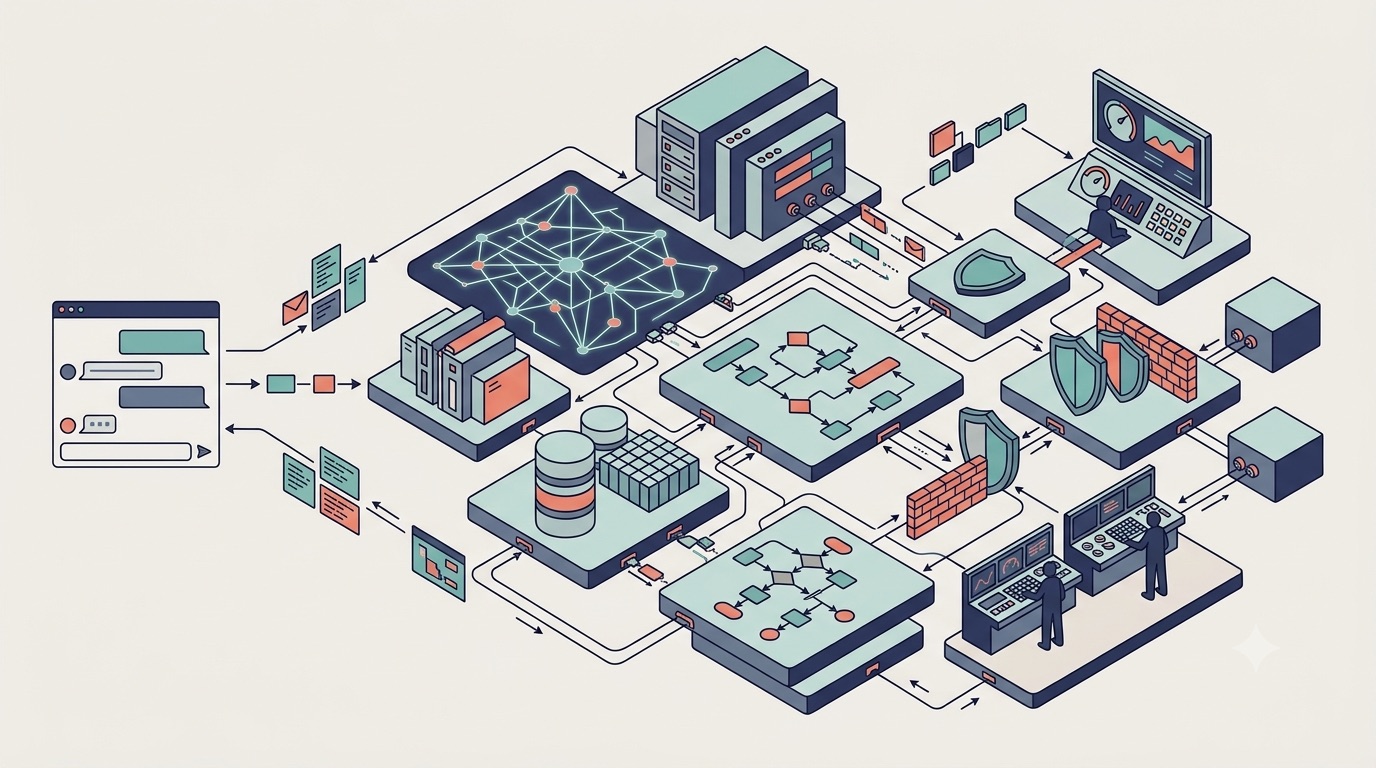
A production AI agent requires a complete software system around the model.
That system needs to connect with existing applications and data, authenticate users, enforce permissions, preserve workflow state, apply business rules, request human approval, record what happened, and recover safely from errors.
A model can suggest an action.
Software determines whether the action is allowed and what happens next.
That distinction is becoming more important as AI products move beyond generating text. The National Institute of Standards and Technology’s (NIST) AI Agent Standards Initiative focuses on agents that can act autonomously, operate securely on behalf of users, and interoperate with the surrounding digital environment. NIST is also exploring practical approaches to identifying agents and authorizing their access and actions. (NIST)
Those are not model-selection questions.
They are software-development questions.
Key takeaways
- An AI agent is not a standalone model. It is a software product that includes integrations, permissions, workflow logic, interfaces, monitoring, and recovery.
- The hardest part is often connecting the agent to the organization’s real systems and rules without giving it too much authority.
- Software developers are needed to turn informal business processes into explicit, testable workflows.
- Human review should be designed into the product rather than added as a generic approval button.
- Agent testing must cover APIs, permissions, business rules, failures, and unintended actions—not merely the quality of generated responses.
- Organizations should begin with one bounded workflow that has a clear owner and a measurable outcome.
What is the difference between a chatbot and an AI agent?
The most useful distinction is not how the product describes itself.
It is what the software can do.
A chatbot responds
A chatbot answers questions or generates content.
It may explain a policy, summarize a document, or help someone locate information. The output remains inside the conversation until a person decides to act on it.
The potential value is real.
The operational risk is relatively contained.
An assistant prepares work
An assistant may retrieve approved information, draft a response, compare options, or recommend a next step.
It can help someone work faster, but the person remains in control of the business process.
The assistant prepares the email.
A person sends it.
The assistant summarizes the account.
A person decides what to change.
An agent changes something
An agent can interact with other software and take action.
It may update a customer record, create a support case, submit an order, schedule a service, modify a project plan, or trigger another automated process.
That is where the software-development challenge changes.
The system is no longer producing information for someone to consider.
It is participating in the operation of the business.
The model is only one component
Organizations understandably spend time comparing AI models.
They evaluate response quality, speed, cost, context windows, tool use, and support for their preferred cloud environment.
Those choices matter.
But they do not answer most of the questions that determine whether an agent will succeed in production.
Consider an agent designed to handle routine customer-order exceptions.
The agent may need to:
- Understand what the customer is requesting.
- Confirm the customer and order.
- Retrieve payment, fulfillment, and account information.
- Determine which policy applies.
- Check whether the request falls within an allowed threshold.
- Prepare a proposed resolution.
- Request approval when necessary.
- Update several systems.
- Notify the customer.
- Record the decision and its supporting evidence.
The model may contribute to understanding the request and recommending a resolution.
But the agent cannot complete the workflow safely without custom software.
Someone has to build the connections to the order, payment, inventory, and customer systems.
Someone has to determine which source is authoritative when the systems disagree.
Someone has to implement the thresholds that should never be left to model judgment.
Someone has to prevent the agent from issuing the same credit twice when an API times out.
Someone has to design the screen an employee uses to review an unusual case.
And someone has to make sure the entire process can be tested.
That is the real product.
Software developers turn business knowledge into an operational system
Most organizations already know a great deal about the workflow they want to improve.
The knowledge may live in policy documents, training materials, spreadsheets, application settings, database fields, support notes, and the experience of the people who perform the work every day.
It rarely arrives as a clean specification.
A manager may say:
“We can normally approve this, unless the account is new, the amount is unusually high, or the order has already received an exception.”
An experienced employee understands what that means.
Software does not.
A development team has to turn that knowledge into explicit behavior:
- What counts as a new account?
- Where does the system find the account age?
- What amount is unusually high?
- Does the threshold differ by product or customer?
- Which exceptions disqualify the order?
- What happens when the exception history is incomplete?
- Who may override the rule?
- What evidence must appear during approval?
This is one reason a generic agent cannot simply be connected to “company data” and expected to perform useful work.
Business processes contain ambiguity, exceptions, competing sources, and institutional knowledge.
Software developers work with domain experts to make those details concrete.
The client understands the business.
The development team turns that understanding into a product the organization can operate and trust.
The integration layer is where the real complexity lives
A useful agent usually needs to work with applications the organization already depends on.
That may include:
- Customer relationship management software
- Enterprise resource planning systems
- Internal databases
- Document repositories
- Support platforms
- Payment services
- Scheduling tools
- Identity providers
- Reporting systems
- Custom legacy applications
Some of those systems will have modern APIs.
Some will have incomplete APIs.
Some will contain duplicate or inconsistent information.
Some will be difficult to change because other parts of the business depend on their current behavior.
The agent needs more than access.
It needs an integration layer that can translate between systems, validate incoming data, manage errors, preserve state, and expose a safe set of operations.
That layer may need to answer questions such as:
- Which system owns a particular field?
- What happens when two applications disagree?
- Can the operation be repeated safely?
- How should rate limits and outages be handled?
- Which fields may be sent to the AI provider?
- What should be cached, and for how long?
- How will the system know whether an update succeeded?
- What happens when only part of a multi-step operation completes?
A prototype may bypass these questions.
Production software cannot.
Permissions have to be designed, not implied
An employee may have broad access because their role requires them to handle many different situations.
An agent assigned to one workflow does not need the same authority.
Suppose an operations manager can view all customer accounts, approve large credits, change account terms, and export reports.
An agent helping that manager review a routine exception may only need to:
- Read a specific order
- Read a limited portion of the customer record
- Check prior exceptions
- Prepare a credit below a defined amount
- Send the proposal for approval
Giving the agent all of the manager’s permissions would be easier.
It would also create unnecessary risk.
A software development team can design the agent as a distinct actor with its own identity and narrowly defined capabilities. It can separate permission to read information from permission to prepare, submit, approve, or reverse an action.
It can also make access contextual.
The agent may be allowed to read one customer’s information while completing one case for a limited period of time.
That is very different from receiving permanent access to the entire customer database.
NIST’s work on software and AI-agent identity reflects the growing importance of identifying agents, controlling their privileges, auditing their actions, and determining on whose behalf they are operating. (NIST Computer Security Resource Center)
The principle is familiar to experienced developers:
Give each part of the system only the authority it needs.
Agents make that principle more important, not less.
Business rules should not all become model decisions
Large language models are useful because they can work with ambiguous, unstructured information.
That does not mean every decision should be ambiguous.
Many parts of a business workflow are better handled by ordinary software.
A model may interpret what a customer is asking.
Deterministic code should probably enforce the maximum credit the agent can prepare.
A model may classify an incoming document.
A rules engine may determine the required retention period.
A model may summarize the history of a support case.
The application should decide which roles may view the summary.
This division of responsibility matters.
Traditional software is often better for:
- Exact calculations
- Permission checks
- Eligibility rules
- Required fields
- Monetary thresholds
- State transitions
- Duplicate prevention
- Regulatory constraints
- Actions that must behave consistently
AI is useful where the workflow requires interpretation, synthesis, or reasoning across less structured information.
Good agent architecture does not ask the model to do everything.
It gives each part of the system the job it is best suited to perform.
Human approval is a product feature
We believe it’s vital to “keep a human in the loop.”
A development team still needs to decide:
- Which actions require approval?
- Who is qualified to approve them?
- What information should the reviewer see?
- How quickly must the decision be made?
- Can the request be reassigned?
- What happens when no one responds?
- Can the reviewer change the proposal?
- How is the decision recorded?
A generic approval prompt is rarely enough.
Imagine receiving this message:
The agent recommends approving this exception. Continue?
That does not help the reviewer understand the recommendation.
A useful interface might show:
- The customer’s request
- The records the agent consulted
- The relevant policy
- The proposed resolution
- The financial or operational effect
- Missing or conflicting information
- The reason human review was required
- The actions that will occur after approval
This is product design.
The reviewer is a user with a job to complete, limited time, and responsibility for the result.
The approval experience should be designed with the same care as the agent itself.
Agents need ordinary software reliability
AI agents introduce new behavior.
They do not eliminate familiar software failures.
Databases become unavailable.
APIs time out.
Credentials expire.
Records change while a workflow is running.
Users submit incomplete information.
External systems accept an update but fail to return a response.
An agentic workflow needs the same reliability engineering expected of other business-critical software.
That may include:
- Explicit workflow states
- Validated API inputs
- Bounded retries
- Idempotent operations
- Duplicate-action prevention
- Checkpoints
- Timeouts
- Circuit breakers
- Error queues
- Manual recovery tools
- Compensating transactions
- Alerts and operational dashboards
Suppose an agent creates a refund but times out before receiving confirmation.
Should it try again?
Not until the software determines whether the first request succeeded.
Otherwise, a temporary network problem can become a duplicate payment.
The model cannot solve that by reasoning harder.
Developers need to design the transaction correctly.
Auditability has to be built into the architecture
When an agent participates in business decisions, the organization needs to be able to reconstruct what happened.
That may require recording:
- Who initiated the workflow
- Which agent and software version handled it
- Which systems and records were consulted
- Which tools were called
- Which rules and policies were applied
- What the agent proposed
- What a person approved or rejected
- What action was ultimately taken
- Which records changed
- Which errors or retries occurred
This is not simply a transcript of the agent’s conversation.
A useful audit trail should represent the business process.
It should connect the input, decision, approval, action, and outcome in a form that developers, operators, security teams, and business owners can understand.
Logging also needs limits.
Retrieved documents, prompts, API responses, and model outputs may contain confidential information. Recording everything can create a new security and privacy problem.
Developers need to decide what evidence is necessary, what should be redacted, who may access it, and how long it should be retained.
Testing the model is not enough
An agent may perform well in a demonstration and still fail in production.
That is because the demonstration usually tests the happy path.
Real software has to handle everything else.
A complete testing strategy should ask:
- Does the agent retrieve the correct record?
- Are tenant and user boundaries enforced?
- Can it call only approved tools?
- Are tool inputs validated?
- Can untrusted content alter its instructions?
- Does it act when required information is missing?
- Does it recognize conflicting data?
- Are monetary and policy limits enforced outside the model?
- Can a timeout cause the same action to occur twice?
- Does a model or prompt update change workflow outcomes?
- Can the system continue safely when the model is unavailable?
- Does the human reviewer receive enough information?
- Can the organization recover from a partial failure?
Developers may need integration tests, security tests, adversarial scenarios, evaluation datasets, regression tests, and simulations of failed dependencies.
They also need release practices.
Changing a prompt, model, retrieval strategy, or tool description can alter the agent’s behavior. Those changes should be versioned, tested, reviewed, and deployed deliberately.
An agent should not become a part of the business that changes invisibly.
The user interface still matters
Agentic AI is sometimes presented as though the interface will disappear.
A user will express an intent, and the agent will handle everything else.
Some workflows may become that simple.
Many will not.
Users still need to:
- Start or configure a task
- Supply missing information
- Review recommendations
- Understand system status
- Resolve exceptions
- Correct mistakes
- Inspect prior actions
- Pause or stop a workflow
- Take over when automation cannot continue
Those interactions need thoughtful software design.
A person should know whether the agent is gathering information, waiting for another system, requesting approval, retrying an operation, or unable to proceed.
They should also know what the agent has and has not done.
Without that visibility, automation can make a workflow harder to understand even when it makes parts of it faster.
Buying an AI platform does not remove the need for developers
Organizations do not necessarily need to build every AI component themselves.
They may use a commercial model, an agent framework, a cloud AI service, a vector database, or vendor-provided connectors.
That can be a sensible approach.
But purchasing those components does not produce a finished workflow.
The organization still needs to determine:
- How the agent fits into its architecture
- Which data it can use
- How users authenticate
- Which actions are available
- Where business rules are enforced
- How approvals work
- What information leaves the organization
- How failures are handled
- How the system is monitored
- How vendor changes will be evaluated
- How the agent will evolve with the business
Off-the-shelf tools can reduce the amount of infrastructure a team has to create.
They do not eliminate the need to understand and engineer the product.
Why should an organization start with one workflow?
Because the first agent project should answer a practical question:
Can this system improve a real business process without creating more risk or complexity than it removes?
A company-wide AI initiative is too broad to answer that clearly.
A bounded workflow gives the organization something it can design, build, measure, and learn from.
A strong first candidate usually has:
- A clear trigger
- A defined completion point
- A known business owner
- Repetitive work
- Accessible data
- A limited number of systems
- Explicit decision rules
- Manageable consequences
- A measurable baseline
The goal might be to reduce handling time, improve consistency, shorten a queue, decrease manual data entry, or help employees resolve more cases without switching among several applications.
The outcome should be observable.
“We deployed an agent” is not a business result.
Where Art+Logic fits
Art+Logic has spent decades designing and developing custom software for organizations with complex requirements. That work includes custom web and cloud applications, internal workflow tools, SaaS platforms, system modernization, and AI-enabled software. (Art+Logic)
AI-agent development belongs in that same practice.
The work begins with the organization’s domain knowledge:
- How the business process actually operates
- Which exceptions matter
- Which systems contain authoritative information
- Which actions require judgment
- Where the current workflow creates friction
- What the organization is and is not willing to automate
Developers turn that knowledge into working software.
They design the architecture, connect the systems, define tool interfaces, enforce permissions, encode deterministic rules, create review experiences, build audit trails, test failure conditions, and prepare the product to change over time.
AI does not replace that work.
It creates a new reason to do it carefully.
Art+Logic’s role is not simply to place a conversational interface in front of an existing model. It is to help build the application around the model—the part that makes AI useful inside a real organization.
That may mean adding AI capabilities to an existing product.
It may mean creating a workflow tool that combines model reasoning with conventional software.
It may mean modernizing an older system before an agent can interact with it safely.
Or it may mean determining that a simpler automation would solve the problem more reliably.
The goal is not to use the most AI.
It is to build the right software.
Your business doesn’t need an agent everywhere
Agentic AI creates an appealing picture.
Workflows become faster. Systems coordinate automatically. Employees spend less time gathering information and more time making important decisions.
Some organizations will achieve that.
They will not get there by selecting a model and connecting it to every application they own.
They will get there one workflow at a time.
They will define the job clearly.
They will decide which parts require AI and which should remain conventional software.
They will limit what the agent can access and do.
They will design meaningful human review.
They will test the entire system rather than the quality of a few responses.
And they will involve software developers early enough to shape the product—not after the demonstration is already being treated as a solution.
Because an agent that can take action is not merely an AI feature.
It is part of your software architecture.
It is part of your security model.
It is part of your operating process.
And it needs to be engineered that way.
FAQs
Why do AI agents require software developers?
An AI model can interpret information and suggest actions, but developers must connect it to business systems, enforce permissions, implement rules, manage workflow state, design user interactions, handle failures, create audit trails, and test the complete product.
Is an AI agent the same as a chatbot?
No. A chatbot primarily generates conversational responses. An agent can use tools and take actions in other software systems. That added authority creates requirements for authentication, authorization, testing, monitoring, human review, and recovery.
What is the hardest part of enterprise AI integration?
The hardest part is often the software around the model. The agent must work with existing applications, inconsistent data, permissions, business rules, exceptions, and people. Those integration and product-design challenges are specific to each organization.
Can an off-the-shelf AI platform replace custom development?
An AI platform may provide models, agent frameworks, or connectors, but organizations still need to integrate those components with their architecture, data, permissions, workflows, and governance requirements. Custom development is often necessary to make the resulting system fit the business.
Which decisions should be handled by conventional software?
Exact calculations, eligibility requirements, monetary thresholds, permission checks, required fields, state transitions, and other rules that must behave consistently are usually better enforced with deterministic software. AI is more useful for interpreting or synthesizing less structured information.
When should an AI agent require human approval?
Approval should generally remain mandatory for consequential, irreversible, unusual, low-confidence, or policy-exception actions. The reviewer should receive the evidence, applicable rules, uncertainties, and expected effects needed to make a meaningful decision.
How should an AI agent be tested?
Test the complete workflow, including model behavior, data retrieval, tool selection, API integrations, permissions, business rules, adversarial inputs, timeouts, duplicate prevention, approval steps, audit logging, and recovery from partial failures.
What is a good first AI-agent project?
Start with a bounded, repetitive workflow that has a clear owner, accessible data, explicit rules, manageable consequences, and a measurable baseline. The first project should demonstrate a business result, not merely that the organization can deploy an agent.