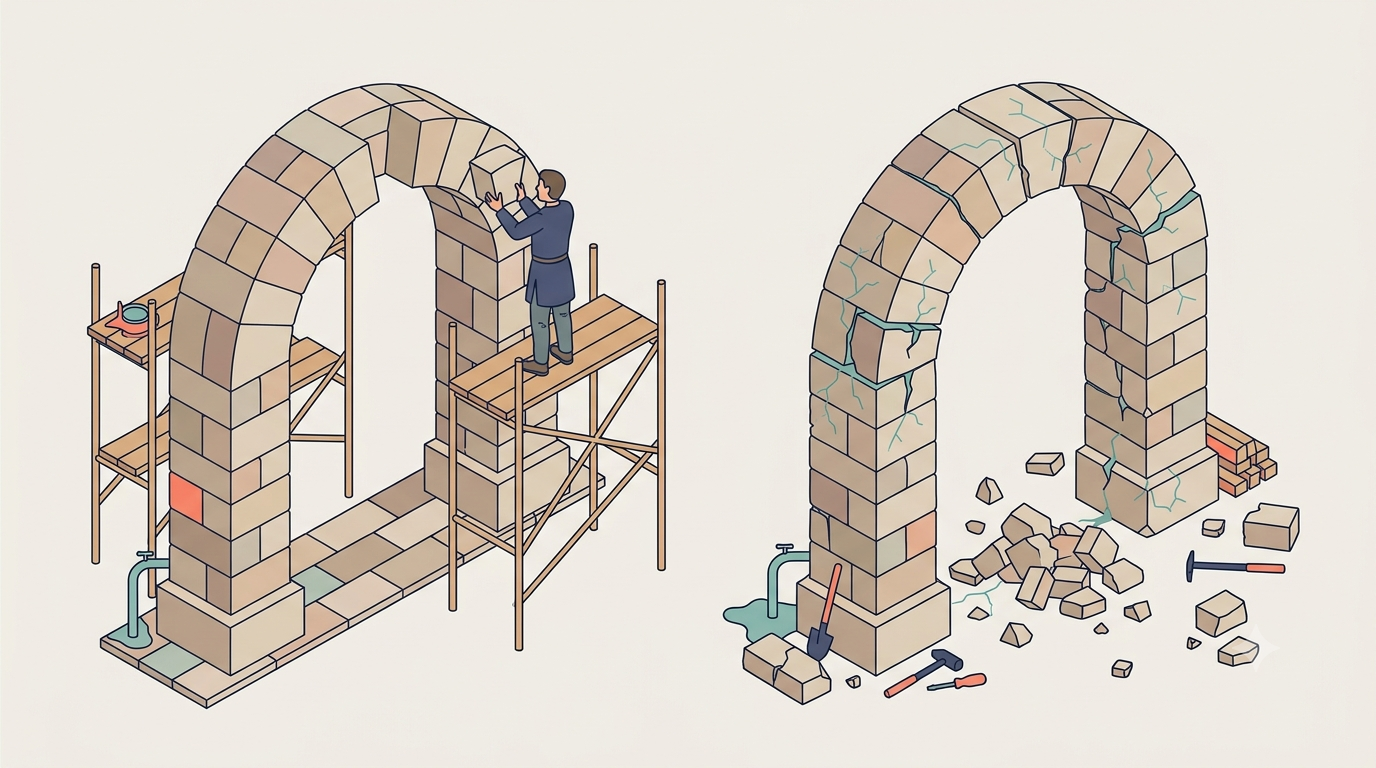
When an engineer leaves, the initial plan usually feels manageable: someone else will step in, spend a few days getting up to speed, and keep the roadmap moving forward. However, this is often the moment when the questions begin. Suddenly, the team finds themselves wondering why changing a simple field breaks the reporting process, or which service is actually responsible for a specific calculation. They might encounter a dependency that everyone is afraid to touch or find that the application behaves unpredictably in production without any clear explanation.
It's in these moments that turnover stops being a staffing problem and becomes a clear architectural signal. The departure didn’t create the fragility; it simply revealed that the system’s health depended on knowledge held in a specific person’s memory rather than knowledge expressed through clear architecture, comprehensive tests, and consistent development practices.
What does employee turnover reveal about software architecture?
Turnover reveals weak architecture when a team cannot safely understand, maintain, or change a system without the people who originally built it.
Healthy software can absorb normal changes in personnel. New developers still need time to learn the product, but the system gives them reliable ways to discover how it works.
Fragile software depends on memory. Its important rules are implicit. Its boundaries are unclear. Its unusual behavior makes sense only when someone remembers the conversation that produced it. When that person leaves, the company does not merely lose an employee. It loses part of the application’s operating context.
Key takeaways
- Turnover doesn’t usually create architectural weakness. It exposes weakness that was already present.
- A system has high key-person risk when critical knowledge exists in individual memory rather than in its structure, tests, and documentation.
- Documentation helps, but it can’t compensate for tangled architecture or inconsistent code.
- AI-assisted development can increase the amount of software teams produce without automatically increasing shared understanding.
- Modular design, automated testing, visible architectural decisions, and consistent patterns make systems easier for new developers to understand.
- Reducing key-person dependency does not require documenting every line of code. It requires making the system’s important behavior and intent discoverable.
- When an application has already become difficult to understand, an architecture assessment or phased modernization can create a safer path forward.
Why does turnover affect some software teams more than others?
Every team changes.
People accept new roles, move to different projects, retire, take leave, or pursue other opportunities. A durable software system should be able to continue through those ordinary changes.
The problem is not that knowledge leaves with people. Some knowledge always will.
The problem is how much of the system depends on knowledge that exists nowhere else.
Art+Logic’s original Two Minutes on Tech_ discussion identified several common warning signs:
- Only one or two people understand critical workflows
- Documentation no longer matches the software
- New developers need an unusually long time to become productive
- Changes are delayed until a particular person is available
- Teams avoid modifying areas they don't fully understand
These conditions can remain hidden for years while the right people are still around. Turnover makes the dependency visible. (Art+Logic)
A system may be functioning normally right up until the organization needs someone new to change it.
That's why production uptime alone doesn't tell you whether an application is maintainable.
The more useful question is:
Could a capable developer who didn't build this system understand and safely change it?
What is key-person dependency in software?
Key-person dependency exists when a system relies too heavily on the knowledge, availability, or judgment of a small number of people.
Engineering teams sometimes describe this as the “bus factor”: how many people could become unavailable before the project becomes difficult to continue.
The phrase is usually treated as a team-management concern.
But the underlying problem is often architectural.
Suppose one engineer knows:
- Why a billing calculation contains several unexplained exceptions
- Which scheduled process has to run before monthly reports
- Which parts of the system cannot be deployed independently
- Why a seemingly unused database column can't be removed
- Which integration fails when records arrive in an unexpected order
- How to recover when a production deployment stops halfway through
That person may be exceptionally capable. But the organization has also made them part of the infrastructure. The system remains stable because the engineer can interpret behavior that the software itself doesn't explain.
Strong architecture distributes that understanding.
Clear boundaries, consistent patterns, meaningful names, tests, observable workflows, and recorded decisions allow more people to reason about the application. Art+Logic describes this distinction directly: weak architecture concentrates knowledge, while strong architecture makes system intent easier to discover. (Art+Logic)
Why is software being built faster than teams can understand it?
Teams have always been able to create technical debt under deadline pressure.
AI-assisted development increases the speed at which it can happen.
A developer can now generate a feature, integration, data model, or application structure much more quickly than before. That speed can be genuinely valuable.
But producing code faster is not the same as building shared understanding faster.
A generated solution may work without the team having fully discussed:
- Why the components are separated in a particular way
- Which assumptions the implementation makes
- How the feature should behave when data is incomplete
- Which business rules belong in deterministic code
- What will happen when another team needs to extend it
- Whether the pattern is appropriate for the rest of the application
- How the new behavior will be tested and supported
When these decisions remain implicit, understanding becomes concentrated in the person closest to the implementation.
Sometimes even that person can't fully explain the result.
They may know that the generated code passed the immediate test. They may not know how its assumptions will affect the application six months later.
AI didn't invent this problem.
It compressed the time between an idea and a large amount of working code.
That makes architecture, review, testing, and documentation more important—not less.
Art+Logic’s AI-assisted modernization work follows the same principle. AI was used for repetitive, pattern-based implementation, while experienced developers retained responsibility for architecture, code review, testing, and validation. (Art+Logic)
The useful question is not:
How much code can the team generate?
It is:
How much software can the organization continue to understand?
Why doesn’t documentation solve the whole problem?
When someone leaves, the first response is often:
“We need better documentation.”
That's probably true.
But documentation can't rescue a system whose structure remains difficult to reason about.
A hundred-page guide may describe a tangled application in detail. The application's still tangled.
A diagram may show dozens of dependencies. It doesn't make those dependencies safer to change.
A comment may explain that a method should never be called before another method. It doesn't remove the hidden sequence dependency.
Documentation supports good architecture. It doesn't replace it.
Art+Logic makes the same distinction in its guidance on turnover and maintainability: documentation is important, but a poorly structured system remains difficult to maintain even when it's extensively described. Good architecture reduces how much explanation the system requires because boundaries and intent are visible in the design. (Art+Logic)
The best documentation answers questions the code cannot answer for itself:
- Why was this approach selected?
- Which alternatives were considered?
- What business rule does this component protect?
- Which constraint would make the decision worth revisiting?
- Who owns the surrounding process?
- What should never change without broader review?
Documentation is most useful when it preserves intent. The architecture still has to make that intent practical.
What does architecture that survives turnover look like?
There's no single architecture that prevents knowledge loss.
A small internal application and a large regulated platform don't need the same architecture.
But systems that remain maintainable through team changes tend to share several characteristics.
The boundaries make sense
A developer can identify where a business capability begins and ends.
Billing logic isn't scattered across the user interface, database triggers, scheduled tasks, and several unrelated services.
Authentication behavior isn't reimplemented differently in each feature.
Components have responsibilities that a new team member can explain.
Clear boundaries don't eliminate complexity.
They keep complexity from spreading.
Important behavior is covered by tests
Automated tests provide more than defect detection.
They show developers what the organization expects the software to do.
A test can reveal that a calculation must preserve a particular rounding rule, that an API must reject a certain state transition, or that a workflow depends on an unusual edge case.
Without that safety net, a new developer has to choose between two bad options:
Change code they don't fully trust, or leave a known problem alone.
Art+Logic’s software-development approach emphasizes automated testing alongside modular design and explicit architecture decisions as part of keeping long-lived systems maintainable. (Art+Logic)
Patterns are consistent
The same kinds of problems are solved in similar ways.
A developer who understands one feature can use that knowledge to navigate another.
Inconsistent architecture has the opposite effect. Every part of the system feels like a separate application with its own assumptions, conventions, and failure modes.
Consistency reduces the amount of new context someone must absorb.
Decisions are visible
Not every architectural decision needs a formal committee or a lengthy report.
Important decisions should still leave a trace.
A short architecture decision record can explain why the team selected a queue, separated a service, accepted a dependency, or rejected a simpler-looking approach.
That context prevents future developers from “fixing” a strange decision without understanding the constraint it addressed.
It also helps the team recognize when that constraint no longer applies.
The system can be observed
Developers need ways to see what the software is doing.
Useful logs, monitoring, error reporting, workflow status, and deployment history reduce dependence on the person who has learned to interpret obscure symptoms.
A system that fails silently creates institutional knowledge quickly.
Someone eventually learns that a particular delay means a job is stuck or that a certain error message points to an unrelated integration.
Observability turns those private interpretations into shared evidence.
Operational work is repeatable
Building and deploying the software shouldn't depend on a sequence someone remembers.
Recovery procedures shouldn't exist only as a conversation in a messaging channel.
The more specialization is automated and repeatable, the less risk a personnel change creates.
How can leaders recognize architecture that depends on individuals?
The clearest warning signs often appear in everyday work rather than in a formal architecture review.
Work waits for one person
A feature, deployment, or production investigation can't proceed until a particular engineer is available. Occasional specialization is normal.
A repeated inability to move without one person suggests that the system’s knowledge is too concentrated.
Estimates vary according to who is doing the work
A change takes one engineer a day because they know the hidden dependency. The same task takes another developer two weeks because they have to rediscover it. That difference may look like a skill gap. It may actually be a system-understanding gap.
Onboarding means learning the workarounds
New developers are taught which files not to touch, which tests are unreliable, and which deployment steps “usually” work.
This is operational knowledge.
But when the onboarding process centers on undocumented exceptions, the architecture is asking people to memorize its weaknesses.
Refactoring feels too dangerous
The team knows an area needs improvement.
No one can confidently predict what depends on it.
So the code remains unchanged while more features are added around it.
The problem becomes harder to isolate with every release.
Documentation is written only when someone leaves
Exit documentation can be helpful.
It's also a warning sign when the organization’s primary knowledge-management practice begins after a resignation.
Maintainability has got to be built during ordinary development, not reconstructed during a notice period.
The roadmap slows after personnel changes
Some loss of momentum is expected.
But when modest turnover causes an extended decline in delivery confidence, leadership should examine the system—not only the replacement process.
Is turnover always evidence of bad architecture?
No.
Complex software takes time to learn.
Some systems require specialized knowledge because the problem itself is specialized. A developer joining a medical, financial, industrial, scientific, or hardware-integrated application may need substantial domain context before making critical changes.
The objective is not to make every part of the system immediately understandable to anyone.
It's to make the learning path reliable.
A healthy complex system may require weeks of onboarding.
A fragile system requires years of accumulated memory.
The difference is whether a new developer can progressively build an accurate mental model from the code, tests, architecture, documentation, and people who remain.
Specialized knowledge isn't the same as hidden knowledge.
What should a company do after turnover exposes the problem?
The first priority is usually continuity.
The organization needs to stabilize immediate work, identify urgent knowledge gaps, and reduce the risk of further disruption.
But the response shouldn't stop with replacing the person who left.
That simply starts rebuilding the same dependency around someone else.
A practical response may include the following.
Identify the highest-risk knowledge concentrations
Which workflows, services, deployments, integrations, or business rules can only one person explain?
Which areas are avoided because the team doesn't trust them?
Which knowledge gaps could affect revenue, customers, security, compliance, or operations?
Start with consequences, not documentation volume.
Observe the system before changing it
Review the architecture, code, infrastructure, data flows, deployment process, tests, monitoring, and operational history.
Talk to developers and users.
Compare what people believe the system does with what it actually does.
This is especially important in long-lived software, where business logic may be spread across code, configuration, database procedures, integrations, and manual workarounds.
Add a behavioral safety net
Before restructuring a fragile area, establish tests around the behavior that must be preserved.
That might include unit tests, integration tests, end-to-end workflows, data comparisons, or characterization tests that capture current outputs.
The goal is to make changes observable.
Improve one boundary at a time
A company does not have to redesign the entire platform before it can reduce key-person risk.
It may begin by isolating a critical calculation, replacing an undocumented integration, standardizing deployment, or moving shared business rules into a well-tested component.
Smaller improvements create knowledge the team can use in the next phase.
Record decisions as the team makes them
Do not wait until the modernization is complete to document the reasoning.
Capture important decisions while the alternatives, constraints, and business context are still fresh.
Share ownership through real work
Knowledge transfer is more effective when another developer uses the knowledge.
Pair on changes. Rotate support responsibilities. Review designs across the team. Ask someone unfamiliar with the component to follow the documentation and complete a low-risk task.
A document that no one has tested may not be usable documentation.
When does weak architecture require modernization?
Not every confusing codebase needs to be rebuilt.
The right response depends on how strongly the architecture is affecting the business.
A focused refactor may be enough when the problem is limited to one component.
A broader modernization may be justified when:
- The system depends on unsupported technology
- Critical behavior cannot be tested reliably
- Architecture problems repeatedly delay the roadmap
- The application cannot support needed integrations
- Security improvements are difficult to implement
- Operational knowledge is dangerously concentrated
- Teams cannot change the software without introducing regressions
- The cost of preserving the current system keeps increasing
Modernization should still be phased where possible.
Art+Logic begins legacy work by auditing the code and infrastructure, then developing a plan to stabilize, refactor, replatform, or rebuild according to the system’s needs. Its modernization approach emphasizes manageable increments rather than unnecessary disruption. (Art+Logic)
The goal is not newer technology for its own sake.
It is a system the organization can understand and continue changing.
Where Art+Logic fits
Art+Logic designs and develops custom software intended to remain reliable and maintainable beyond its initial release.
That includes new applications, long-lived platforms, legacy modernization, AI-assisted development, and the recovery of software that reached working code before it reached production-ready architecture.
The work often begins with the questions turnover brings to the surface:
- Where is critical knowledge concentrated?
- Which parts of the architecture are difficult to explain?
- What behavior must be preserved?
- Where are developers relying on memory or workarounds?
- Which changes feel riskier than they should?
- What does the business need the software to support next?
Art+Logic combines the client’s domain expertise with experienced software development practices. Its teams use modular design, automated testing, explicit architecture decisions, documentation, and an adaptable development process to build systems that can evolve as requirements—and people—change. (Art+Logic)
That may involve strengthening an existing architecture.
It may mean modernizing a fragile legacy application in phases.
It may mean bringing engineering structure to a rapidly generated AI project.
Or it may mean building a new product with maintainability designed in from the beginning.
The specific technology will vary.
The principle does not.
A system should not become unintelligible when its original developer leaves.
Architecture should preserve context
Turnover will happen.
The goal is not to prevent every departure or capture everything an engineer has ever learned.
The goal is to build software that does not require perfect continuity to remain safe and useful.
Strong architecture preserves context.
It makes important boundaries visible.
It turns expected behavior into tests.
It records the reasoning behind decisions.
It gives new developers a path from unfamiliarity to understanding.
And it allows the team to keep moving when people change.
Because when one person leaves and the whole system becomes uncertain, the departure is not the root problem.
It is the first clear evidence of what the architecture was hiding.
FAQs
How does turnover reveal weak software architecture?
Turnover reveals weak architecture when the team can no longer understand or safely change a system after a particular engineer leaves. The departure exposes undocumented assumptions, unclear boundaries, inconsistent patterns, and business rules that were preserved through individual memory rather than the software itself.
What is key-person dependency in software development?
Key-person dependency exists when critical knowledge, access, or decision-making ability is concentrated in one or two people. The organization becomes vulnerable because important development, deployment, recovery, or maintenance work cannot continue normally without them.
What is the bus factor in software engineering?
The bus factor describes how many team members would have to become unavailable before a software project became difficult to maintain. A low bus factor usually indicates concentrated knowledge, limited documentation, unclear ownership, or architecture that only a small number of people understand.
Is documentation enough to prevent software knowledge loss?
No. Documentation is important, but it cannot compensate for tangled architecture, hidden dependencies, or inconsistent code. Maintainable systems combine useful documentation with clear boundaries, automated tests, repeatable operations, observable behavior, and visible architectural decisions.
How does AI-assisted development affect key-person risk?
AI can help teams build software faster, but it does not automatically create shared understanding. If generated code is accepted without architectural review, testing, and explanation, the people closest to the generation process may become the only ones who understand—or believe they understand—the result.
What makes software architecture easier for new developers to understand?
Helpful characteristics include modular boundaries, consistent patterns, meaningful names, automated tests, current architecture diagrams, recorded decisions, reliable development environments, observable workflows, and repeatable deployment and recovery processes.
Does a difficult-to-understand system need to be rewritten?
Not necessarily. The appropriate solution may be better testing, targeted refactoring, improved observability, clearer documentation, replacement of one fragile integration, replatforming, or phased modernization. A full rewrite should be chosen only when it offers a better risk and value profile than incremental improvement.
How can Art+Logic reduce key-person dependency?
Art+Logic can assess the application’s architecture, code, infrastructure, workflows, tests, and documentation; identify where knowledge and risk are concentrated; and create a phased plan to stabilize, refactor, modernize, or rebuild the appropriate parts of the system.