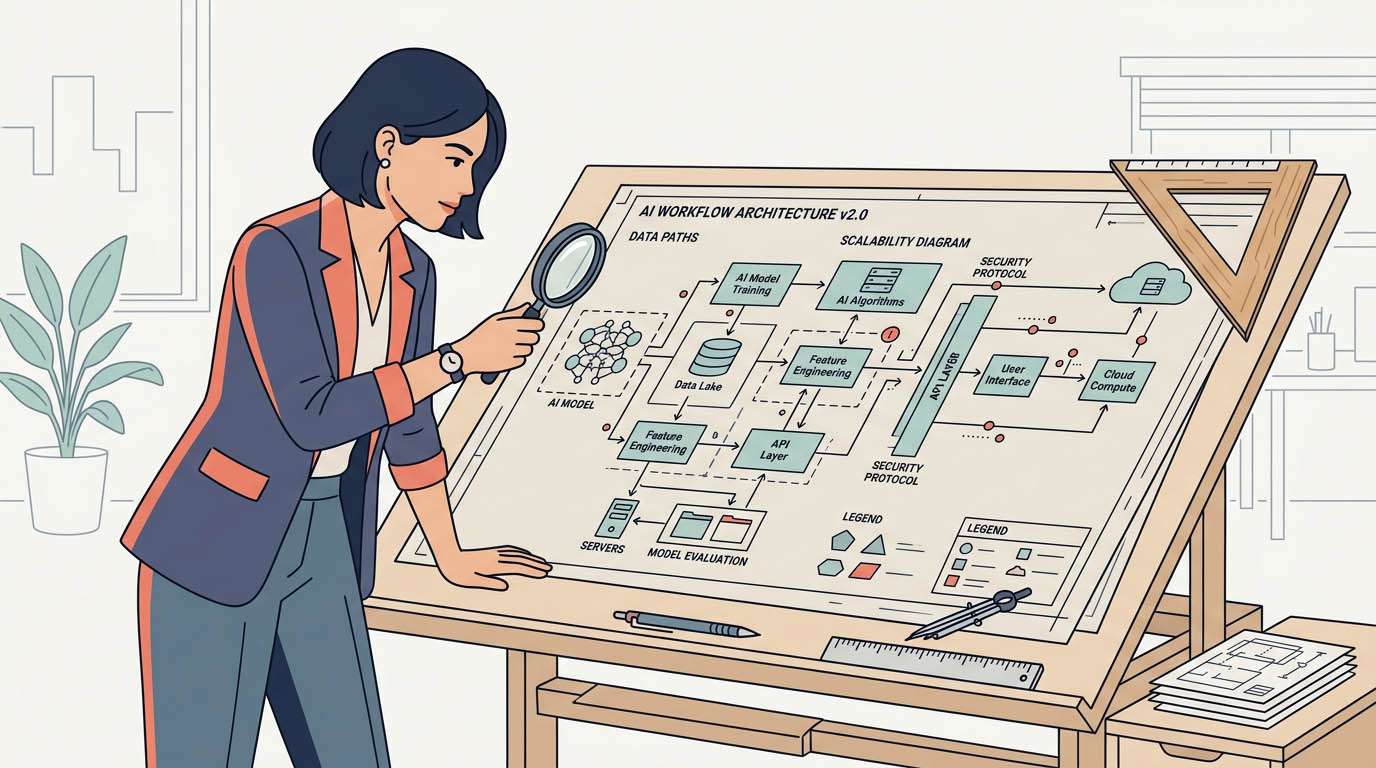
CEOs should evaluate AI investments by asking whether the investment improves a measurable business outcome, changes a real workflow, keeps humans appropriately involved, has a realistic path to production, and creates value that outweighs cost and risk.
The best AI investments are not simply tool purchases; they are business capability investments. That means the question is not just “Can AI do this?” It is: “Can we build, integrate, govern, and maintain an AI-enabled system that makes the business meaningfully better?”
That distinction matters.
AI can summarize documents, draft content, analyze data, generate code, classify requests, and recommend next steps. But those capabilities do not become business value on their own. They become valuable when they are designed into real software systems, connected to real workflows, monitored by real people, and supported by engineers who understand what the system is doing and why.
At Art+Logic, we think that distinction is critical. AI can accelerate parts of the software process, but it does not replace software engineering. Code generated with AI still needs architecture, review, testing, security, maintainability, documentation, and ownership. A model can suggest code, but it cannot be responsible for the code; that responsibility still belongs to people.
The CEO AI Investment Framework
A practical AI investment review should cover six areas:
| Evaluation Area | CEO Question | Why It Matters |
|---|---|---|
| Business value | What measurable outcome will improve? | AI should connect to revenue, cost, speed, quality, risk, or customer value. |
| Workflow fit | What process changes if this succeeds? | AI creates value when it changes how work gets done, not when it sits beside existing work. |
| Data readiness | Is the data accurate, accessible, secure, and usable? | Poor data quality can stop AI projects from scaling. |
| Human oversight | Where do people need to review, approve, override, or understand AI output? | Humans need to stay accountable for high-impact decisions and production software. |
| Governance and risk | What could go wrong, and who owns it? | AI needs clear boundaries, especially when it affects customers, decisions, or regulated processes. |
| Scale economics | What will this cost to operate in production? | Pilot costs rarely reflect the full cost of a reliable AI capability. |
This framework helps CEOs separate promising AI investments from expensive distractions.
Why Should CEOs Treat AI as a Software Investment?
CEOs should treat AI as a software investment because AI only creates durable value when it is embedded into systems people can trust, use, and maintain.
A standalone AI tool may help an individual employee work faster. A custom AI-enabled system can reshape a workflow, connect to existing business data, support governance, and create a repeatable capability.
That is where an experienced software development firm can add value. At Art+Logic, we see AI work as part of custom AI-driven software that can automate workflows, surface key trends, translate natural language into system actions, parse and summarize documents, and accelerate asset generation, including code, copy, and media. (Art+Logic)
The important word there is software.
AI is not useful because it is impressive in isolation. It is useful when it is designed into the right product, interface, workflow, database, integration, permission model, testing process, and operating environment.
That is the difference between a demo and a system the business can depend on.
Why Should AI Investments Start With Business Outcomes?
AI investments should start with business outcomes because the tool itself is not the strategy.
A vendor demo, a boardroom trend, or an internal push to “use AI” is not enough reason to invest. The investment should be tied to a business result the company already cares about.
Strong AI investment goals include:
- Increasing revenue
- Reducing operating cost
- Improving customer experience
- Accelerating software or product delivery
- Improving decision quality
- Reducing risk
- Creating a new product capability
- Strengthening competitive advantage
For example, “We want an AI chatbot” is not a complete business case.
A better version is: “We want to reduce support resolution time while maintaining or improving customer satisfaction.”
“We want AI for engineering” is also too broad.
A stronger version is: “We want to shorten software delivery cycles while maintaining code quality, security, transparency, and maintainability.”
The CEO’s role is not to choose the model. It is to make sure the investment is pointed at a business problem worth solving.
What Types of AI Investments Should CEOs Compare?
Not all AI investments should be judged by the same standard. A productivity tool, an internal decision-support system, a customer-facing AI feature, and an autonomous workflow agent have different costs, timelines, risks, and payoff profiles.
CEOs should usually compare AI investments across four categories.
| AI Investment Type | Best Use | CEO Question | Main Risk |
|---|---|---|---|
| Productivity AI | Speeding up knowledge work | What will we do with the time saved? | The value stays theoretical. |
| Decision support | Improving business decisions | What decision gets better? | Poor data or unclear accountability. |
| Customer-facing AI | Improving product or service experience | Does this improve trust and usability? | Brand, legal, or customer harm. |
| Agentic AI | Automating bounded workflows | Is the process well understood? | Uncontrolled action or escalating cost. |
The more deeply AI is connected to business operations, the more important software engineering becomes.
A simple writing assistant may require light governance. An AI feature inside a customer product requires much more: interface design, testing, integration, security, monitoring, auditability, escalation paths, and a clear answer to the question, “Who is responsible when this system is wrong?”
How Should CEOs Evaluate AI-Assisted Software Development?
CEOs should evaluate AI-assisted software development carefully. AI can help engineers move faster, but it does not remove the need for engineering judgment.
This is one of the easiest places to misunderstand AI.
AI can generate code. That does not mean AI has designed a system. It does not mean the code is secure. It does not mean the architecture is appropriate. It does not mean the implementation is maintainable. It does not mean the business logic is correct. It does not mean the code will still make sense six months from now.
A responsible software team uses AI as an accelerator, not as an unquestioned authority.
Human software engineers still need to:
- Understand the business requirements
- Choose the right architecture
- Review AI-generated code
- Test edge cases
- Identify security risks
- Preserve maintainability
- Document important decisions
- Monitor system behavior
- Refactor when requirements change
- Take responsibility for the final product
This is especially important for CEOs because software is not only an asset at launch. It is an asset over time.
A system that no one understands is a liability, even if it works today. A codebase that cannot be explained, maintained, secured, or extended will slow the business down later.
The CEO question is: Can our engineers explain, own, and maintain the code behind this AI-enabled system?
If the answer is no, the investment is not ready to scale.
Why Is Human-in-the-Loop AI Important?
Human-in-the-loop AI is important because AI systems can be useful without being fully autonomous.
In many business settings, the right goal is not to remove people from the process. The right goal is to help people make better decisions, move faster, reduce repetitive work, and focus on higher-value judgment.
That is especially true when AI affects customers, financial decisions, compliance, security, hiring, healthcare, legal review, product quality, or production software.
A human-in-the-loop design can include:
- Human review before an AI recommendation is acted on
- Approval steps for high-risk outputs
- Escalation paths when confidence is low
- Clear visibility into source data or reasoning context
- Logging and audit trails
- Feedback loops that improve future performance
- Override controls
- Limits on what the AI system is allowed to do automatically
This does not make AI less valuable. It makes AI more usable.
We emphasize embedding AI into real operational workflows while keeping humans firmly in the loop. (Art+Logic) That is a practical way to think about enterprise AI: not as a black box that replaces judgment, but as software that supports better human and organizational performance.
What Value Does a Software Development Partner Add to AI Investments?
A software development partner adds value by turning an AI idea into a working, maintainable, secure system.
That value matters because most AI failures do not happen because the model cannot produce an impressive answer. They happen because the business cannot integrate that capability into real operations.
Gartner predicted that at least 30% of generative AI projects would be abandoned after proof of concept by the end of 2025 because of poor data quality, inadequate risk controls, escalating costs, or unclear business value. (Gartner)
Those are not purely AI problems. They are software, data, product, and operating model problems.
An experienced development partner can help CEOs and leadership teams answer questions like:
- What should we build, buy, or integrate?
- Which workflow is worth improving first?
- What data does the system need?
- How should humans review or approve outputs?
- What parts of the workflow should remain deterministic?
- How should the AI connect to existing systems?
- What should be logged, monitored, or audited?
- How do we test quality before launch?
- How do we keep the system maintainable?
- How do we avoid creating a black box no one owns?
Art+Logic works on custom software, AI development, web apps, legacy upgrades, automation, secure software development, and technically difficult projects. The company has been designing and developing custom software since 1991 and has built software for more than 900 clients across industries. (Art+Logic)
That kind of experience matters because AI projects still have all the hard parts of software projects: requirements, architecture, integration, user experience, security, deployment, testing, change management, and long-term maintenance.
AI does not remove those needs. It raises the stakes.
How Should CEOs Evaluate Productivity AI?
Productivity AI helps employees write, research, summarize, analyze, code, search internal knowledge, or automate repetitive tasks.
These tools can produce fast wins, but their ROI is often harder to measure than it first appears. Time saved does not automatically become money saved. If employees save three hours a week but the company does not increase throughput, improve quality, reduce cost, or reallocate capacity, the value may remain theoretical.
The key CEO question is: What will we do with the time we save?
Will teams handle more customer volume? Ship software faster? Reduce vendor spend? Improve proposal quality? Shorten sales cycles? Reallocate people to higher-value work?
Without that second-order benefit, productivity AI becomes a convenience rather than a strategic investment.
For software teams specifically, AI-assisted development should be evaluated by more than speed. CEOs should also ask whether quality, security, documentation, testing, and maintainability are improving or declining.
Fast code is not automatically good software.
How Should CEOs Evaluate AI for Decision Support?
AI decision-support systems help leaders and teams analyze data, identify patterns, forecast outcomes, or recommend actions.
Examples include demand forecasting, churn prediction, pricing support, fraud detection, operational planning, and financial scenario modeling.
The value is not just automation. It is better judgment at scale.
The key CEO question is: What decision improves, who makes it, and how will we know the decision got better?
A decision-support investment should have a clear link to a recurring business decision. It should also define how recommendations will be reviewed, when humans remain accountable, and how the company will measure whether decisions improve over time.
AI can support a decision. It should not obscure responsibility for that decision.
How Should CEOs Evaluate Customer-Facing AI?
Customer-facing AI includes capabilities embedded into products, platforms, services, or support experiences.
Examples include personalization, recommendations, natural language interfaces, intelligent onboarding, automated support, AI-assisted design tools, and domain-specific copilots.
These investments can create differentiation, but they also carry higher brand and trust risk. A bad internal AI answer may waste time. A bad customer-facing AI answer may damage credibility, expose sensitive information, or create legal risk.
The key CEO question is: Does this improve the customer experience enough to justify the operational and reputational risk?
Customer-facing AI should be evaluated not only for accuracy but also for usability, transparency, escalation paths, privacy, security, and failure handling.
This is another place where software engineering is essential. The user experience around the model often matters as much as the model itself.
Can the user tell when they are interacting with AI? Can they correct it? Can they escalate to a person? Can the system explain where an answer came from? Can the business trace what happened if something goes wrong?
Those are product and engineering questions, not just AI questions.
How Should CEOs Evaluate Agentic AI?
Agentic AI refers to systems that can take actions across tools, workflows, or systems with some degree of autonomy.
This area is attracting heavy executive interest, but it requires extra discipline. Gartner predicted that over 40% of agentic AI projects would be canceled by the end of 2027 because of escalating costs, unclear business value, or inadequate risk controls. (Reuters)
That does not mean CEOs should ignore agentic AI. It means they should apply a higher bar.
Agentic systems are most promising when the workflow is valuable, repeatable, well-bounded, observable, and connected to clear business metrics. They are risky when the workflow is ambiguous, exception-heavy, poorly documented, or dependent on judgment the organization cannot clearly define.
The key CEO question is: Are we automating a well-understood business process, or are we asking AI to compensate for a process we do not understand?
For agentic AI, human-in-the-loop design becomes even more important. The system should have clear limits on what it can do, when it must ask for approval, what actions are logged, and how a human can intervene.
Autonomy without accountability is not a business capability. It is a risk.
What Is the Real Cost of an AI Investment?
The real cost of an AI investment includes much more than software licenses or model usage.
A pilot may only require a few users, a small technical team, and limited API spend. A production AI system usually requires a broader operating model.
CEOs should expect serious AI investments to include some combination of:
- Data preparation and cleanup
- System integration
- Security review
- Cloud infrastructure and model usage
- Vendor evaluation and procurement
- Legal and compliance review
- User experience design
- Workflow redesign
- Training and change management
- Human review processes
- Testing and evaluation
- Monitoring and maintenance
- Incident response planning
- Ongoing model, prompt, and data updates
- Software documentation
- Code review and refactoring
- Observability and logging
- Long-term ownership
A useful rule for CEOs: If the estimate only includes the AI tool, it is not a complete estimate.
The model may work, but the business environment around it may not be ready. That is where many AI business cases break down.
Why Does Workflow Redesign Matter for AI ROI?
Workflow redesign matters because AI creates value when it changes how work gets done.
Giving employees access to AI tools may improve individual productivity. But larger gains usually come from redesigning workflows around AI-enabled capabilities.
McKinsey’s 2025 global AI survey found that workflow redesign had the biggest effect on an organization’s ability to see EBIT impact from generative AI. The same survey reported that 21% of respondents whose organizations use generative AI said their organizations had fundamentally redesigned at least some workflows. (McKinsey & Company)
That distinction is important.
AI adoption means people have access to tools.
AI value means the business has changed a workflow in a measurable way.
For example, giving a sales team an AI writing assistant may help individual sellers move faster. Redesigning the sales proposal process with AI-assisted research, reusable knowledge, pricing guidance, legal review support, and CRM integration may change the economics of the whole function.
The same applies to software development. AI coding tools can improve individual productivity, but larger gains require disciplined engineering workflows: clearer requirements, better testing, stronger code review, improved documentation, deployment automation, and maintainable architecture.
The CEO question is simple: What workflow changes if this succeeds?
If the answer is “nothing,” the investment is probably too shallow.
How Should CEOs Think About AI Governance?
CEOs should treat AI governance as part of the investment case, not as an afterthought.
Governance is often framed as a brake on innovation. In reality, good governance is what allows AI to scale.
Without governance, companies risk shadow AI, inconsistent data handling, unclear accountability, duplicated tools, uncontrolled costs, unmanaged security exposure, unreliable outputs, and code no one fully understands.
With governance, teams have clearer rules for where AI can be used, what data is allowed, who approves high-risk use cases, how outputs are reviewed, how code is tested, and how systems are monitored.
Regulation is also becoming more concrete. The EU AI Act entered into force on August 1, 2024, and is scheduled to become fully applicable on August 2, 2026, with some exceptions. (Digital Strategy)
Even companies outside the EU should pay attention to this direction. Customers, regulators, insurers, partners, and enterprise buyers are increasingly likely to ask how AI systems are governed.
A practical AI governance review should answer:
- Who owns the AI system?
- What data can and cannot be used?
- What security and privacy controls are required?
- When is human review required?
- How will outputs be tested?
- How will AI-generated code be reviewed?
- What happens when the system is wrong?
- How will performance be monitored after launch?
- How will the company respond to incidents?
- Who is responsible for maintaining the system over time?
The governance should match the risk. An internal brainstorming assistant does not need the same oversight as an AI system that affects hiring, lending, medical guidance, legal review, financial decisions, customer eligibility, or production infrastructure.
But every AI investment needs boundaries.
What Metrics Should CEOs Use to Measure AI ROI?
CEOs should measure AI ROI using business metrics, not just usage metrics.
Usage can show adoption, but it does not prove value. A tool can be widely used and still fail to improve business performance.
Better AI ROI metrics include:
| Business Goal | Possible AI ROI Metric |
|---|---|
| Reduce cost | Lower cost per ticket, transaction, claim, report, or workflow |
| Improve speed | Shorter cycle time, faster response time, reduced backlog |
| Increase revenue | Higher conversion, larger deal velocity, better retention |
| Improve quality | Fewer errors, fewer rework cycles, better customer satisfaction |
| Increase capacity | More throughput without proportional headcount growth |
| Reduce risk | Fewer compliance issues, better anomaly detection, improved auditability |
| Improve delivery | Faster software releases, fewer defects, shorter review cycles |
| Improve maintainability | Lower technical debt, clearer documentation, easier onboarding |
| Improve transparency | Better traceability, explainability, logs, and review workflows |
A strong AI business case should explain the baseline, the expected improvement, and the method for measurement.
For example, “save 10,000 hours” is not enough. The better question is: Which hours, whose hours, what happens next, and what business result changes?
For AI-assisted software development, “more code shipped” is not enough either. The better question is: Are we shipping better software faster, with clear ownership and less long-term risk?
Should CEOs Build, Buy, or Partner on AI?
CEOs should choose build, buy, or partner based on strategic importance, differentiation, control, cost, and speed.
Buy when the capability is common, non-differentiating, and well-served by mature tools. Examples may include meeting summaries, basic document drafting, internal productivity assistants, or commodity support features.
Build when the capability is central to differentiation, depends on proprietary workflows or data, or must be deeply embedded into the product or operating model.
Partner when the opportunity is strategically important but the company needs outside software, AI, product, data, or architecture expertise to execute safely and effectively.
The CEO-level question is: Where do we need ownership, and where do we simply need utility?
A software development partner like Art+Logic can be especially valuable when the AI investment touches custom workflows, proprietary systems, legacy software, complex integrations, regulated environments, or product differentiation.
In those cases, the challenge is rarely “Can we call an AI API?” The challenge is building a system that works reliably inside the business.
What Should an AI Investment Proposal Include?
A CEO-ready AI investment proposal should include:
- The business problem
- The proposed AI-enabled capability
- The workflow change required
- The expected value
- The full cost
- The data requirements
- The human-in-the-loop design
- The software architecture
- The risks and controls
- The owner
- The implementation path
- The success metrics
- The plan for testing, monitoring, and maintenance
- The decision point for scaling, changing, or stopping
That level of clarity makes AI less mysterious. It also makes it more useful.
A good AI investment case should not simply say, “This technology is powerful.” It should explain how the business will use that power responsibly to improve a measurable outcome.
What Are the Biggest Red Flags in AI Investment Proposals?
CEOs should watch for these warning signs:
- The business case is based only on generic productivity assumptions.
- The team cannot explain the workflow impact.
- The proposal depends on clean data the company does not have.
- The demo uses examples that are much simpler than real-world work.
- No one has budgeted for integration or change management.
- Legal, security, or compliance teams are brought in only at the end.
- The system has no clear owner after launch.
- Success is measured by usage instead of business impact.
- The project requires high trust in outputs but has weak testing.
- AI-generated code is accepted without engineering review.
- The team cannot explain how the system works.
- The system has no human override path.
- The investment is justified mainly by fear of falling behind.
Fear is not a strategy. Neither is experimentation without a path to value.
What Is the Best AI Investment Strategy for CEOs?
The best AI investment strategy is a portfolio strategy.
A healthy AI portfolio includes a mix of near-term productivity gains, operational improvements, and strategic bets.
Near-term productivity gains help teams build AI fluency and identify practical use cases.
Operational improvements target measurable workflows where better automation, analysis, or decision support can improve business performance.
Strategic bets explore new products, services, business models, or defensible capabilities that may take longer to mature.
The portfolio should be reviewed regularly. Some experiments should be stopped. Some should be merged. Some should receive more funding. Some should move from innovation budgets into operating budgets.
That last point matters.
Once an AI system becomes part of how the business runs, it is no longer an experiment. It is infrastructure.
And infrastructure needs engineering discipline.
Final Takeaway: CEOs Should Evaluate AI as Responsible Software
AI can be transformative, but only when it is evaluated as more than technology.
For CEOs, the mandate is clear: do not evaluate AI by the quality of the demo. Evaluate it by the quality of the business case, the workflow design, the human oversight model, and the engineering discipline behind it.
The companies that create lasting value with AI will not necessarily be the ones that spend the most or automate the fastest. They will be the ones that connect AI investments to measurable business outcomes, redesign workflows around those capabilities, keep humans responsible where it matters, and build software that can be trusted, explained, maintained, and improved.
AI investment is a strategy decision. It is an operating model decision. It is a governance decision. It is a software engineering decision. And increasingly, it is a leadership decision.
FAQs
How should CEOs evaluate AI investments?
CEOs should evaluate AI investments by asking whether they improve a measurable business outcome, change a real workflow, include appropriate human oversight, have a realistic path to production, and create value that outweighs cost and risk.
Why should CEOs treat AI as a software investment?
CEOs should treat AI as a software investment because AI only creates durable value when it is integrated into reliable systems, workflows, data sources, interfaces, security controls, and maintenance processes. A demo is not the same thing as production software.
Why is human-in-the-loop AI important?
Human-in-the-loop AI is important because people need to remain accountable for high-impact decisions, customer-facing actions, regulated workflows, and production software. Human oversight helps improve accuracy, trust, transparency, and risk management.
Can AI write production code without software engineers?
AI can generate code, but software engineers still need to review, test, secure, document, maintain, and take responsibility for that code. AI-generated code should be treated as a starting point, not as a finished software product.
What value does a software development firm add to an AI project?
A software development firm can help turn an AI idea into a working system by designing the architecture, integrating data and tools, building user workflows, testing outputs, managing risk, reviewing code, and ensuring the software remains maintainable over time.
What is the most important question CEOs should ask about AI ROI?
The most important question is: what business result will improve? AI ROI should be measured through outcomes such as lower cost, faster cycle time, higher revenue, better customer experience, improved quality, increased capacity, reduced risk, or better maintainability.
Why do AI projects fail after proof of concept?
AI projects often fail after proof of concept because the demo works, but the business environment is not ready. Common causes include poor data quality, unclear business value, escalating costs, weak governance, integration challenges, and lack of workflow redesign.
Should CEOs focus on AI tools or AI capabilities?
CEOs should focus on AI capabilities. A tool is only valuable if it helps the business do something meaningfully better, such as make faster decisions, automate a high-value workflow, improve a customer experience, or create a differentiated product feature.
What should every AI investment proposal include?
Every AI investment proposal should include the business problem, proposed capability, expected value, workflow impact, data requirements, human oversight model, software architecture, full cost, risks, governance controls, owner, implementation path, success metrics, and maintenance plan.
How should CEOs decide whether to build, buy, or partner on AI?
CEOs should buy AI when the capability is common, build when it is strategically differentiating, and partner when the opportunity is important but the company needs outside software, AI, product, data, or architecture expertise to execute safely and effectively.