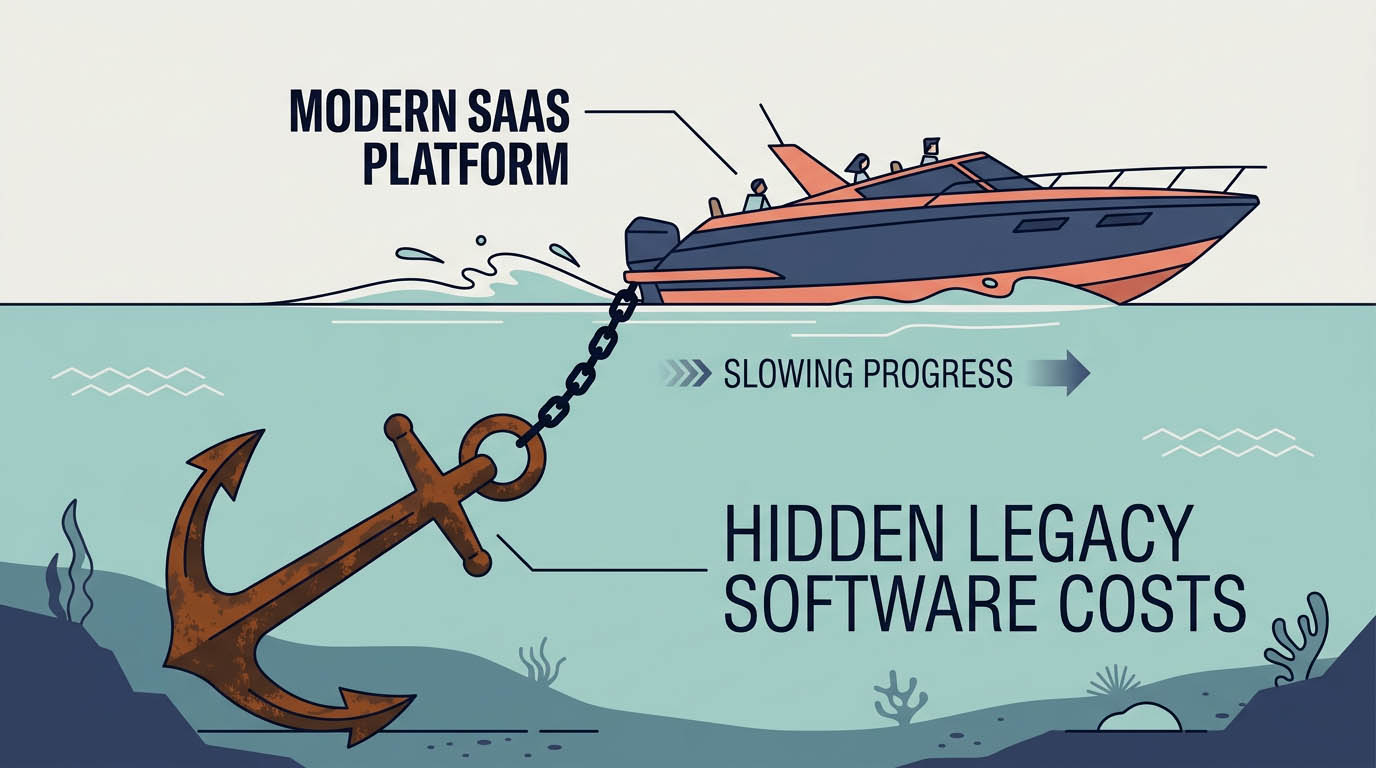
Legacy software is rarely “bad” software.
In many cases, it is the opposite. It is the system that helped a company grow, supported years of operations, encoded hard-won business rules, and kept critical workflows moving long after newer tools came and went. That is why legacy systems tend to survive: they are doing something important. They contain operational knowledge, customer workflows, integrations, reports, permissions, exceptions, and decisions that may not be documented anywhere else. (Art+Logic)
But that usefulness can make the true cost harder to see.
The visible costs of legacy software are easy to identify: hosting, licensing, support contracts, maintenance tickets, and the occasional emergency fix. The hidden costs are more dangerous because they compound quietly. They show up as slower releases, fragile integrations, frustrated employees, compliance headaches, customer experience gaps, and opportunities the business cannot pursue because the software cannot support them.
The real question is not, “Is this system old?” It is: “What is this system preventing us from doing?”
Legacy Software Creates a Velocity Tax
One of the most common hidden costs of legacy software is speed.
A healthy software system lets teams make small, confident changes. A legacy system often does the opposite. A minor update turns into a multi-week effort because no one knows what else it might break. QA takes longer than development. Releases require manual checklists. Engineers avoid touching certain parts of the codebase because those areas are too risky, too tangled, or too poorly understood.
That is the velocity tax: every feature, fix, and improvement costs more than it should.
One of the clearest signs that a legacy system is holding a business back is when small code changes take days to deploy, or QA cycles stretch longer than the development work itself; the system is no longer just a technical concern. It is costing the business time and money. (Art+Logic)
This tax is easy to normalize. Teams get used to slow releases. Product managers stop asking for certain improvements. Leadership assumes the roadmap is naturally difficult. But underneath that new normal is a software system quietly setting the pace of the business.
Maintenance Starts Replacing Momentum
Legacy software also shifts engineering energy away from value creation.
Instead of building new capabilities, teams spend more time patching brittle code, resolving regressions, investigating production issues, and maintaining workarounds. Refactoring older code rarely looks exciting on a roadmap, but it can be one of the highest-ROI investments a software-driven organization makes because old code does not only slow engineers down; it taxes the whole business. (Art+Logic)
The hidden cost is not just the maintenance work itself. It is what the team is not doing while maintenance consumes their attention. They are not improving onboarding. They are not building customer-requested features. They are not experimenting with new revenue streams. They are not improving reliability, analytics, accessibility, or automation.
Over time, the gap between “what the business needs” and “what the system can support” gets wider. Eventually, even reasonable product ideas start to feel expensive.
Operational Risk Increases Quietly
Legacy systems often fail in subtle ways before they fail dramatically.
Performance slows under load. Nightly jobs require manual babysitting. Integrations break when a vendor updates an API. Reports generate inconsistent results. A process works only because one person knows the workaround. A critical server, library, or framework is no longer actively supported.
These issues may not stop the business immediately, but they raise the cost of operating it.
We’ve got a brief video on legacy systems that calls out several of these hidden costs directly: slow performance, constant workarounds, security vulnerabilities from outdated technology, inability to scale or support new features, integration headaches, and employee time lost to systems that no longer fit the business. Sometimes the system breaks; other times it works “just barely,” but at a high cost. (Art+Logic)
That “just barely” state is risky. It can make teams overly dependent on institutional memory, manual intervention, and luck. The longer that continues, the harder it becomes to predict where the next failure will come from.
Integration Problems Limit Growth
Modern businesses rarely run on one system. They depend on a network of tools: CRMs, ERPs, payment platforms, analytics systems, data warehouses, mobile apps, customer portals, AI tools, marketing automation, and third-party APIs.
Legacy software can become the weak link in that ecosystem.
Older systems may not expose clean APIs. Data may live in formats that are difficult to access. Authentication patterns may not meet modern expectations. Integrations may rely on fragile scripts, manual exports, or custom bridges that only one or two people understand.
That creates a hidden cost every time the business wants to adopt a new tool or connect existing systems in a better way.
Art+Logic identifies integration pain as a major modernization signal: legacy systems often do not play well with newer APIs, tools, or platforms, which makes scaling or even staying current harder than it should be. (Art+Logic)
The business impact can be significant. A company may want better reporting, self-service customer workflows, AI-assisted operations, or smoother internal automation, but the legacy system keeps every initiative dependent on custom glue code.
Compliance and Security Become Harder to Manage
Compliance is not static. Security expectations change. Privacy requirements evolve. Audit standards become more demanding. Vendors stop supporting old dependencies. Attack surfaces expand as systems get connected in new ways.
A legacy system makes all of that harder.
In regulated industries, outdated systems can make compliance updates risky and audits expensive. We see that industries such as finance, healthcare, and insurance face evolving compliance rules, and outdated systems make those updates more difficult to manage. (Art+Logic)
Security risk is similar. A system may still function, but if it depends on unsupported libraries, outdated frameworks, aging infrastructure, or unclear access controls, the business may be carrying risk it cannot easily measure.
The hidden cost is not just the cost of fixing a vulnerability. It is the cost of uncertainty: not knowing whether the system can pass an audit, withstand scrutiny, or adapt quickly when requirements change.
Technical Debt Spills Into Product, Design, Process, and Culture
Technical debt is often treated as an engineering problem, but it rarely stays confined to the codebase.
Art+Logic frames debt more broadly: it can accumulate in product decisions, design patterns, development processes, and company culture. Product debt shows up as feature bloat or unvalidated assumptions. Design debt appears in inconsistent workflows and confusing interfaces. Process debt builds when teams skip documentation, testing, or clear specs. Cultural debt emerges when organizations consistently reward speed over sustainability. (Art+Logic)
Legacy software tends to amplify all of these.
A confusing internal tool leads to more training and support. A fragmented customer experience erodes trust. A weak release process creates firefighting. A culture of “just patch it” trains people to accept instability as normal.
The hidden cost is not just technical complexity. It is organizational drag.
Talent Gets Harder to Hire, Keep, and Ramp Up
Developers generally understand that every production system has a history, and they do not expect perfection. But there is a difference between a mature system and a hostile one.
When a codebase is difficult to understand, painful to test, risky to deploy, or built on technologies few people want to work with, hiring becomes harder, and retention can suffer. New team members take longer to become productive. Senior engineers spend more time explaining landmines than improving architecture.
Art+Logic calls talent friction a modernization warning sign: skilled developers want to work on modern systems, and a dated stack can limit the hiring pool while increasing churn risk. (Art+Logic)
This is one of the most underestimated legacy costs. It does not always appear as a line item called “legacy software expense.” It appears as longer onboarding, lower morale, slower delivery, and valuable engineers spending their creativity on survival instead of progress.
Customer Experience Starts Falling Behind
Legacy systems often expose their age through the customer experience.
Maybe the interface feels dated. Maybe workflows require unnecessary steps. Maybe performance is inconsistent. Maybe customers cannot self-serve because the system was never designed for that. Maybe competitors are shipping better digital experiences faster because their architecture makes change easier.
This is where legacy software becomes a strategic constraint.
The problem is not that the system is old. The problem is that it limits the company’s ability to meet current expectations.
A system built for one stage of the business may not support the next one. To put it plainly, the systems built when a company was scrappy will not necessarily support the company it is becoming. (Art+Logic)
That gap can affect retention, sales, support costs, and brand trust. Customers may not know or care what technology powers the experience. They just feel the friction.
Full Rewrites Can Become Their Own Hidden Cost
When legacy pain becomes severe, the instinct is often to start over.
A full rewrite is appealing because it promises a clean architecture, a modern stack, and freedom from years of accumulated compromises. But rewrites often underestimate how much business knowledge is embedded in the existing system. As teams rebuild, they discover undocumented workflows, edge cases, reporting needs, and integrations that were not included in the original plan. Costs rise, timelines stretch, and confidence erodes. (Art+Logic)
That does not mean replacement is never the right call. Sometimes it is.
But modernization should start with understanding, not demolition. The first step is rarely writing new code. It is figuring out what the current system actually does, what business value it preserves, which parts are still useful, and which parts are creating drag. (Art+Logic)
A legacy system is not one thing. It is a collection of assets, risks, dependencies, and assumptions. Some parts should be refactored. Some should be rebuilt. Some should be retired. Some may be worth keeping exactly as they are.
Modernization Does Not Have to Mean Disruption
One reason companies delay modernization is fear.
They worry that updating a legacy system will interrupt operations, overwhelm internal teams, frustrate customers, or turn into an open-ended rebuild. That fear is understandable. Many legacy systems support critical workflows, and a careless modernization effort can create real disruption.
But the alternative is not “do nothing.”
At Art+Logic, we emphasize incremental modernization: progress can happen one piece at a time, lowering risk, preserving continuity, and giving teams room to adapt as systems evolve. (Art+Logic)
Practical approaches include:
- Decoupling high-friction modules instead of demolishing the entire system.
- Running old and new systems in parallel while production workloads shift gradually.
- Using short-term patching alongside long-term planning when immediate fixes are unavoidable.
- Mothballing defunct systems that no longer serve the business.
- Creating shared infrastructure when old and new systems need to coexist for a period of time. (Art+Logic)
The best modernization work protects what matters while removing what slows the business down.
How to Start Quantifying the Hidden Costs
You do not need a perfect model to start making better decisions. You need visibility.
Begin by looking for places where the system is already costing the business more than it should:
- How long does it take to ship a small change?
- How much engineering time goes to maintenance, incidents, and rework?
- Which features have been delayed because the architecture cannot support them?
- Which workflows depend on manual intervention or undocumented knowledge?
- Where do integrations break most often?
- How long does it take new engineers to become productive?
- Which compliance, security, or audit needs are painful to address?
- Where are customers or internal users creating workarounds?
This exercise often reveals that the cost of legacy software is not a single dramatic failure. It is a pattern of small penalties paid every week.
Once those costs are visible, the modernization conversation changes. Instead of debating whether the system is “old,” teams can prioritize the areas where change will create the most business value.
The Goal Is Not New Software. It Is Future Optionality.
Modernization is not about replacing the past for its own sake.
It is about creating a foundation that can support what comes next. That might mean faster releases, better reliability, improved compliance, stronger integrations, AI readiness, better customer experiences, or new revenue opportunities. We describe successful modernization as controlled evolution: preserving operational stability while removing the constraints that keep the business from adapting. (Art+Logic)
Refactoring fits the same pattern. Done well, it is not polishing code for aesthetic reasons. It improves modularity, removes brittle dependencies, clarifies intent, makes systems easier to test, and helps teams move with confidence. The ROI shows up in faster time-to-market, lower long-term costs, better scalability, improved reliability and security, and happier, more effective teams. (Art+Logic)
Legacy software becomes expensive when it limits choice.
The sooner you understand where those limits are, the more options you have. You can refactor instead of rewrite. Replace one workflow instead of the whole platform. Stabilize risky areas before they fail. Preserve valuable business logic while modernizing the architecture around it.
The hidden costs of legacy software are real. But they are not inevitable.
With the right strategy, modernization becomes less about escaping old code and more about giving the business room to move again.
FAQs
What are the hidden costs of legacy software?
The hidden costs include slower development, higher maintenance effort, operational risk, security and compliance exposure, integration problems, employee frustration, customer experience issues, and missed opportunities for growth.
How do you know if a legacy system is holding your business back?
Common signs include slow deployments, long QA cycles, recurring bugs, difficulty hiring developers, fragile integrations, compliance headaches, and features that are delayed because the system cannot support them.
Is refactoring better than replacing legacy software?
Not always, but refactoring is often the smarter first step. It can reduce risk, improve maintainability, and restore development speed without the disruption of a full rewrite.
Why are full rewrites risky?
Full rewrites often underestimate the amount of business logic, edge cases, workflows, and integrations embedded in the existing system. That can lead to longer timelines, higher costs, and missed requirements.
How should a company start modernizing legacy software?
Start by understanding what the system actually does, where it creates the most friction, and which parts are valuable versus risky. From there, prioritize incremental improvements that reduce business impact while preserving operational continuity.