From the Art+Logic archive · written in 2013. The tools may have moved on; the thinking still holds.
First, I admit it freely: I watch far too much television, far too indiscriminately.
That being said:
The recent series conclusion of the US version of ‘The Office’ gave me an opportunity to go back and re-read the entirety of Venkatesh Rao’s deep and lengthy series of posts (starting all the way back in 2009, finally wrapping up just a few weeks ago on May 16th, 2013) explaining that
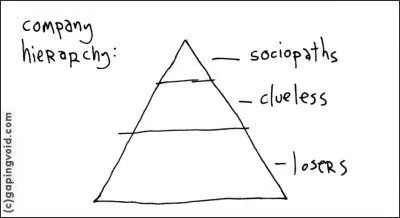
The Office is not a random series of cynical gags aimed at momentarily alleviating the existential despair of low-level grunts. It is a fully realized theory of management that falsifies 83.8% of the business section of the bookstore. The theory begins with Hugh MacLeod’s well-known cartoon, Company Hierarchy (below), and its cornerstone is something I will call The Gervais Principle, which supersedes both the Peter Principle and its successor, The Dilbert Principle.
image from http://gapingvoid.com/2004/06/27/company-hierarchy/
In these posts, Rao outlines how all of the characters on the show can be viewed through this framework of sociopaths, clueless, and losers, and how this analysis helps us understand the actual behaviors that we see in organizations. The nomenclature is perhaps a bit loaded, so it helps to see his definitions:
The Sociopath (capitalized) layer comprises the Darwinian/Protestant Ethic will-to-power types who drive an organization to function despite itself. The Clueless layer is what Whyte called the “Organization Man,” but the archetype inhabiting the middle has evolved a good deal since Whyte wrote his book (in the fifties). The Losers are not social losers (as in the opposite of “cool”), but people who have struck bad bargains economically, giving up capitalist striving for steady paychecks.
To get the most out of this series of posts, it helps to have seen the individual episodes that he analyzes (see, I wasn’t wasting time, I was studying the primary sources that would let me understand the arguments being made here).
After establishing these three archetypes, he continues on to define The Gervais Principle as:
Sociopaths, in their own best interests, knowingly promote over-performing losers into middle-management, groom under-performing losers into sociopaths, and leave the average bare-minimum-effort losers to fend for themselves.
…then continues to use specific examples from the series to show how organizations are affected by the interactions happening between people in the same layer of the Sociopath/Loser/Clueless hierarchy, between people in different layers, and the significance of people moving between layers.
I try to be less cynical as I age, but the arguments made in these pieces rings too true to me to discount them on that basis. I don’t know that I’ve internalized it enough to have it affect how I work as a manager, or how I allow myself to be managed and drive my own career.
Some problems are easier to explain in writing. Send us a few lines about what you're working on, and we'll reply within one business day. Helpful to include: